
In the first part of the material about rare earth resources, I explained why Donald Trump needs Greenland and how the world is beginning wars over rare earths. Be sure to read it to understand what is happening in the world right now! And now I want to continue the thought — as you understood from the first part, around Greenland “little ships” of the United States and China are “floating,” trying to “crush” the Arctic region under themselves and control the supply of raw materials for the technologies of the future.
Everything is simple: whoever controls rare earth resources leads the fourth technological revolution. There are no other interests here.
And today in the world, confident leadership is held precisely by China.
Let’s probably repeat once again the phrase of the PRC leader Deng Xiaoping, which he said in 1992: “The Middle East has oil, China has rare earth elements.”
It turned out to be a very prophetic phrase; the Chinese authorities assessed the horizons of the future world economy perfectly, and while other states were tearing each other’s throats out over oil, China was actively developing the extraction and processing of rare earths. And today, when the world urgently needs to transition to “green energy,” electric vehicles, and global data centers for artificial intelligence, global volumes of rare earth elements have also become necessary.
By the 2020s, China made the whole world dependent on itself — about 70% of global rare earth resource extraction is under the control of the Celestial Empire, as well as up to 90% of processing capacity. On top of that, production of products based on rare earth metals with control above 93%. Accordingly, this dominance gives Beijing an unprecedented lever of influence over global technological chains and the defense industry.
The whole world now depends on Chinese rare earths: Russia and Europe by 90–100%, and the USA by more than 70%.
But what is the secret? Where does China get such huge volumes of rare earth elements?
I’ll start with the fact that the secret of China’s “rare-earth power” lies in a purposeful state policy. Starting from the 1980s, while the West was fascinated by the IT boom and financial reforms, Beijing quietly built an industrial base founded on resource control. At the same time, the Chinese actively pushed out all competitors by providing generous subsidies and cheap loans to all mining companies. On top of that, China didn’t give a damn about any environmental standards — the policy was: “scorch the earth, but get the resources and take control.” That is what made it possible to increase extraction and processing of rare earths!

Then Chinese companies flooded the market with cheap products, forcing competitors in the USA and Australia to shut down. Competing became simply impossible. By the early 2000s, the last major American rare earth mine went bankrupt, leaving China the dominant supplier of these resources.
All this time, Beijing bet not only on resource extraction, as, for example, policy was conducted in Russia, but also on a full production cycle. And as is known, processing rare earth ores is extremely complex and dirty — it requires many stages of chemical separation and results in a colossal amount of toxic waste. And China consciously turned a blind eye to any environmental risks — it just didn’t care; the main thing was to take leadership and control over rare earths as quickly as possible. At the same time, for example, in the West environmental standards, on the contrary, were strengthening, accordingly any production based on rare earths was becoming expensive. Foreign competitors could not withstand the pressure and left the market as bankrupts!
That’s it! The most classic capitalism. China took the lead and the whole world became dependent on it. And now, in the midst of the fourth technological revolution, states are striving to “catch up,” and we are precisely seeing a decrease in the protection status of the last reserves, mass bills on clear-cutting forests, and so on. No more rules.
And now let’s talk about the price China paid for control over rare earths. This will give a very good understanding of what exactly all states have now rushed to do in this mad race.
Back in 1927, geologists discovered colossal volumes of valuable ore in Southern Mongolia, at the Bayan Obo (Baiyun Obo) iron ore deposit in the north of the region. Even before the proclamation of the PRC, the communists took these territories under control — in 1947, two years before the founding of the People’s Republic of China, they established the Inner Mongolia Autonomous Region. That is, they effectively integrated Southern Mongolia into China! These territories were called Inner Mongolia, and in subsequent decades the region’s borders expanded at the expense of adjacent provinces, and by the middle of the 20th century Beijing firmly “crushed” under control a vast territory with huge rare earth reserves.

In the 1950s, China began industrial extraction of these treasures: in 1958 the state company “Baotou Iron & Steel (Baogang)” launched production of rare earth concentrates, and next to the city of Baotou a giant tailings lake appeared for beneficiation waste. Thus, Inner Mongolia became the heart of China’s rare earth industry: ore from the Bayan Obo deposit is delivered to Baotou for processing, and this region accounts for the lion’s share of Chinese (and therefore global) REE production. Today, the world’s largest rare earth mine operates here — the Baiyun Obo open pit, operated by “Inner Mongolia Baotou Steel Union.”
But it must be understood that these territories were free steppes. Unique peoples lived there, with their own culture and traditions. Naturally, local residents were not happy that China “crushed” them under itself.
And here’s why.
With large-scale rare earth mining in Inner Mongolia, global degradation of all ecosystems began, which continues to this day. The land is simply being scorched! The ore processing process includes the use of concentrated acids and produces toxic and even radioactive waste (rare earth ores often contain thorium). Near Baotou, over decades, an entire artificial lake of waste has accumulated — a giant black pond of about 10 km², filled with poisonous sludge. Its waters are oversaturated with chemicals and radionuclides, so neither fish nor algae survive there; the shores are covered with a dense black crust of sediment. Once, in the place of this lake, there were fertile fields of watermelons, eggplants, and tomatoes, but now dead polluted land stretches around.
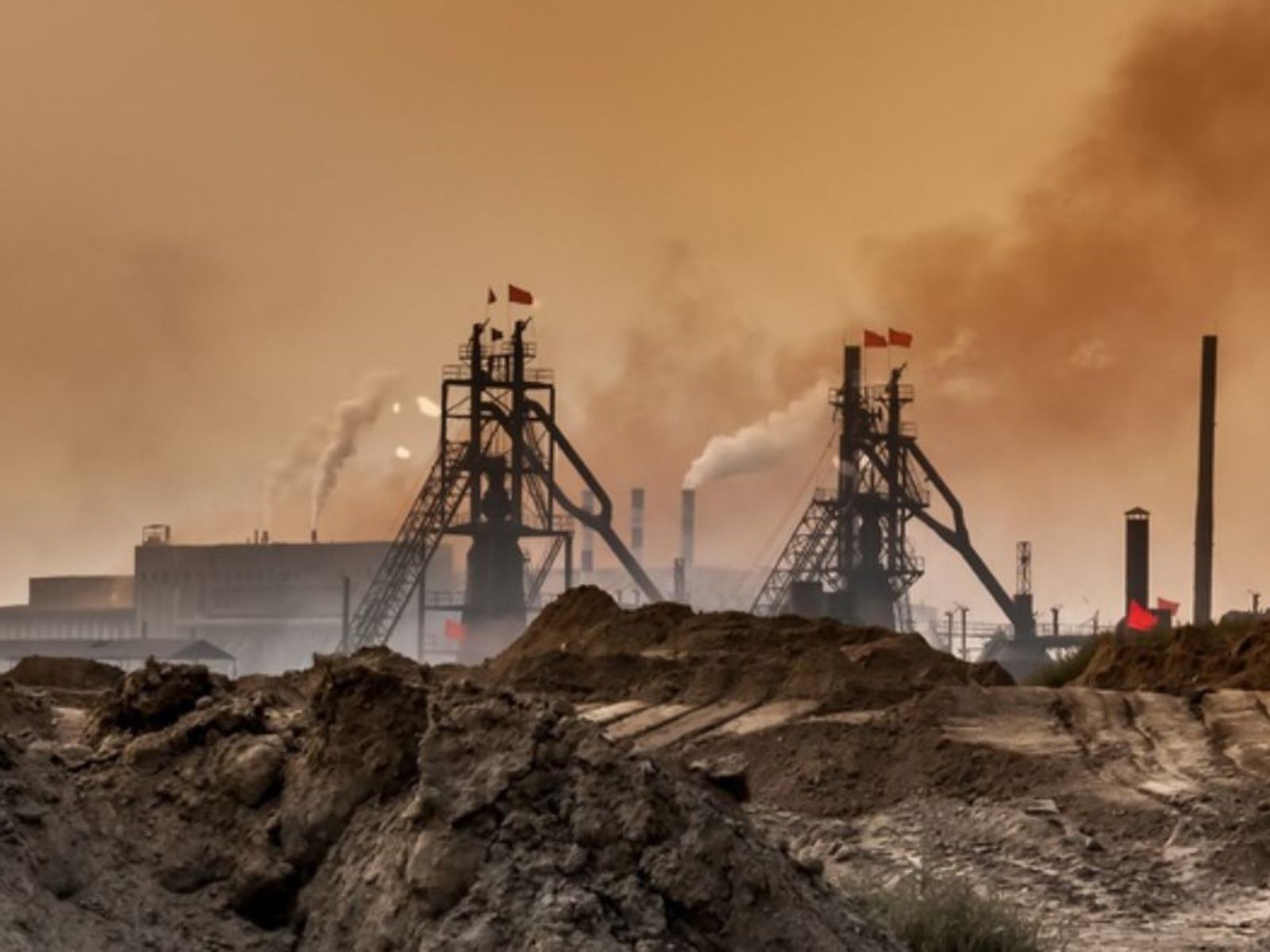
Poisoned groundwater and air led to a surge in diseases: according to some data, every seventh resident of villages around rare earth plants in the Baotou area is affected by cancer. Chinese officials themselves acknowledge that for the sake of achieving national goals they had to sacrifice certain regions and groups of the population — the toxic lakes near Baotou became a vivid example of the government’s readiness to “sacrifice certain places and people for the good of the nation.”
People began to resist; no one wants to die, as it turned out! But they were harshly suppressed, forbidding even simply talking about the problems. This manifested especially acutely in Xinjiang — these are other territories that Beijing took under tight control. The Xinjiang Uyghur Autonomous Region in western China. Historically, this area (East Turkestan) was annexed to the Qing Empire only in the 18th century, and modern Chinese control was established in 1949, when communist troops entered Xinjiang.
This region, besides rare earth resources, is also rich in oil and gas. To seize the territories and exploit them harshly, China began to displace the indigenous peoples — the Uyghurs, which caused dissatisfaction and unrest! The point is that people had already seen how local residents were dying in Inner Mongolia and what happened to their land, so they tried to defend their right to exist.
It didn’t work. After a series of protests (who remembers, for example, the clash in the capital Urumqi in 2009), the central власти switched to a total campaign of “pacifying Xinjiang.”
Since 2014, Beijing has launched a large-scale campaign in Xinjiang under the slogan “people’s war against terrorism,” effectively aimed at suppressing Uyghur identity under the pretext of fighting extremism. In 2016, a tough party functionary Chen Quanguo (previously pursuing a repressive policy in Tibet) was appointed to lead the region. Under his leadership, Xinjiang turned into a real police state, where the newest technologies were integrated specifically to establish total control over the population.
The creation of a network of so-called “political re-education camps” began — by independent estimates, up to 2 million Uyghurs and other small peoples have been detained there without trial or investigation. That is about 10% of the total population! Literally every tenth resident of the region passed through the “political re-education camps.”
People were taken away through kidnappings, often at night, and relatives then долго did not know where they were. In these camps, prisoners are forced to renounce their religion and culture, cram the Chinese language and propaganda slogans. Those who later managed to get out said there was physical violence, as well as constant psychological pressure. This is how the original Uyghur culture was уничтожалась.
It was here that China integrated and tested the social credit system — this is what all states now look at “drooling” and try to pull off the same in their countries. People with a low social credit rating cannot even leave the region, buy tickets, get нормальное education or work. They are like “knocked out” of the social institution with no возможность to recover! Either obey — or life will turn into hell.

Everyday life in Xinjiang is permeated with a system of digital dictatorship and total surveillance. The region became a testing ground for the most modern technologies of population monitoring. According to human rights investigations, authorities collect detailed biometric data from local residents — DNA samples, fingerprints, iris scans, voiceprints — under the pretext of free medical examinations. Tens of thousands of AI video surveillance cameras have been installed in cities and villages, which recognize faces and even try to analyze the emotions of passersby. Smartphones are tracked, chats are read, applications are integrated everywhere that track and transmit all data into unified registries.
You could make a separate piece about this, even write a book! Xinjiang today remains a worked-out example of the embodiment of Orwellian totalitarian control, where high technologies serve the cause of suppressing an entire people.
In Inner Mongolia people are calmer, so China did not exert strong pressure on them — as if they voluntarily gave the land for resource extraction. However, the Mongolian minority also could not avoid жесткой assimilation. In 2020, Beijing decided to significantly reduce teaching in the Mongolian language in local schools, replacing it with mandatory lessons in Putonghua (the Chinese state language). And after that people could no longer stand it — protests began, thousands of parents refused to send their children to classes in знак of disagreement.
The Chinese government reacted instantly — a campaign to suppress dissent was launched, in which all measures of control and suppression tested in Xinjiang were applied at once. Surveillance began, digital control, threats of dismissal, refusal of benefits and loans, putting people on blacklists with bans on traveling abroad and large purchases, as well as arrests of activists. Including those who signed petitions! They were tracked down and punished publicly.
After just a few weeks, all students were forced to return to schools and switch to education in Chinese. At least nine Mongolian teachers and students committed suicide, unable to withstand the pressure and intimidation by the authorities!
Let’s sum up.
This is brief. This is a brief history of how and why China became the leader in the world and made all states dependent on itself! Now other countries want to try the same at home — rare earth mining, without which the world cannot переход to “green energy” and the fourth technological revolution, as well as integration of systems of digital control, social credit and all other “Chinese delights.”
Nature is being destroyed, ecosystems are being ruined, the land is being scorched! And along with them, indigenous peoples are also being destroyed. Now the whole world is doing the same thing: there is a global weakening of any environmental protection norms for the sake of rare earth mining.
In the place of the residents of Greenland, I would carefully study history. And for all of us — it is necessary to continue protecting nature! Our mission is the fight for life. Not only of wildlife, but also for our own lives.
© PAVEL PASHKOV
Support the fight!
The hardest thing in our time is to remain independent from government and business! All activities are carried out independently. Stand with us and support our Mission to protect wildlife.
I want to support!Get involved
On an ongoing basis, we launch public initiatives together to protect wildlife and achieve real change. Join this work and help change the world for the better.
Explore the initiativesTFET Concept
We are working to transform the global protected-area system — Territories of Full Ecological Tranquility (TFET) must be created. Wildlife needs refuges from human pressure! This is one of the key paths out of the planetary ecological crisis and toward preventing further ecosystem collapse.
Learn more
