
A huge problem in wildlife conservation is collective ignorance and distortion of real facts. Many simply do not believe in the destruction of ecosystems, the global nature of the problems, and do not understand or assess the situation on a large scale! No scientific research will help here: after all, it needs to be read, studied, and understood. Few people even finish reading materials to the end, let alone tackle difficult, complex issues. Moreover, to understand the scale of wildlife destruction, problems must be assessed systematically. Our colleagues, for example, have been monitoring these issues for many years, expanding their knowledge horizons and building their understanding of the seriousness of the planetary ecological crisis on practical knowledge.
But how do we convey these problems to the majority of people?
For instance, I write material about Amur tigers, which are now being called to be shot, and the overwhelming majority of people ask questions that we have already answered in earlier materials. But people don't know this! To connect the problems together, they need to delve into the overall topic. And there, other complex issues arise that also need to be studied and verified, and this ocean of knowledge is endless.
I see only one way out: gradually unite millions of people and systematically, persistently develop the idea, talk about the problems, so that society forms a kind of immune response to ecological issues, where the driving force of change will be an active core of people who understand the importance of fighting for Life.
Well, how else?
I think many of our comrades have tried to explain certain issues to their relatives, acquaintances, and friends on social media. Did it work? How many times have you encountered blatant ignorance and distortion of facts? And when you start relying on scientifically proven facts, opponents in the debate begin to resist, intuitively setting themselves the task of "winning at any cost." Even at the cost of denying proven facts.
Now, I want to talk about this.
The fact is, one of the most dangerous phenomena in society today is the distortion of data and the misunderstanding of the real scale of the problem. These boundaries blur over time. For ecosystems, 100–200 years is merely the formation of a local mature biocenosis, and for our planet, it's just a moment. This cannot be said for humans: our lives are quite short. We simply do not have time to comprehend the scale of the collapse we leave behind.
A simple example: a person born in 2000, by 2026, has already formed as an adult member of society. At 26, they are raising a child, working in an office, and steadily paying off loans. During this time, let's say they hear that the population of certain animals is steadily growing, and from their perspective, they see a clear restoration of ecosystems. They read news in the media about new tigers being released into the wild, and at the same time, they read that "at the turn of the last century, there were only 20–30 tigers left in our country, but through the efforts of conservation organizations, the population has been restored to 750 individuals."
Then he reads news from recreational hunting lobbyists claiming that tigers no longer fit in the taiga due to their increased numbers, and therefore, they need to be shot quickly. He also sees media reports about wild cats approaching humans, the deaths of several people, and the subsequent discovery of shot endangered tigers.
And to this 26-year-old member of society, it seems that everything sounds logical: here are the reports that there were a couple of dozen tigers, then it became seven hundred, and then, of course, logically, there are attacks on people. Doesn't it all correlate? How can one not agree with the hunters on the need to shoot the excess tigers to protect people?
Well, how would this person know that there was no count of tiger numbers at the turn of the last century at all?
How would he know that even the approximate total number of tigers worldwide was estimated at 100,000 individuals, whereas now only a few percent of the former population remain?
And how would he know that trophy hunting of rare animals is the most coveted prize for the influential trophy movement in the world, where the wealthy are willing to pay huge sums for the right to kill? And that for their sake, there is constant lobbying for the expansion of opportunities to shoot animals.
He doesn't know that the tiger's habitat has been destroyed, divided between private businesses for 'sport' hunting and logging for export to China. He might have heard something, but he doesn't remember exactly what.
He hasn't read scientific studies, hasn't seen our materials, and even if he sees one of them, he won't read others. This means he won't connect the problems together and won't understand the scale of the destruction of the wild. This is a serious problem in our society.
I want to give an interesting example.
Have you ever seen cryptocurrency charts? How is the financial market structured, drawing in more and more people? I think many have read about this or even personally traded on exchanges after reading news about certain tokens rising by hundreds of thousands of percent. And many have lost their savings there.
So, psychologically, the cryptocurrency market looks like this: if you open the charts of the vast majority of all tokens right now and look at them on a large scale, you'll see that they have dropped up to 99% since their launch. You'll only understand this monstrous decline if you once, say, invested your million and now only have crumbs left of the entire amount. Everything you invested has already been pocketed by other players who benefit from both the operation of the exchange itself and the creation of tokens.
I have prepared an approximate chart for you to show what this looks like in practice, that is, the current state of the vast majority of cryptocurrencies on exchanges.
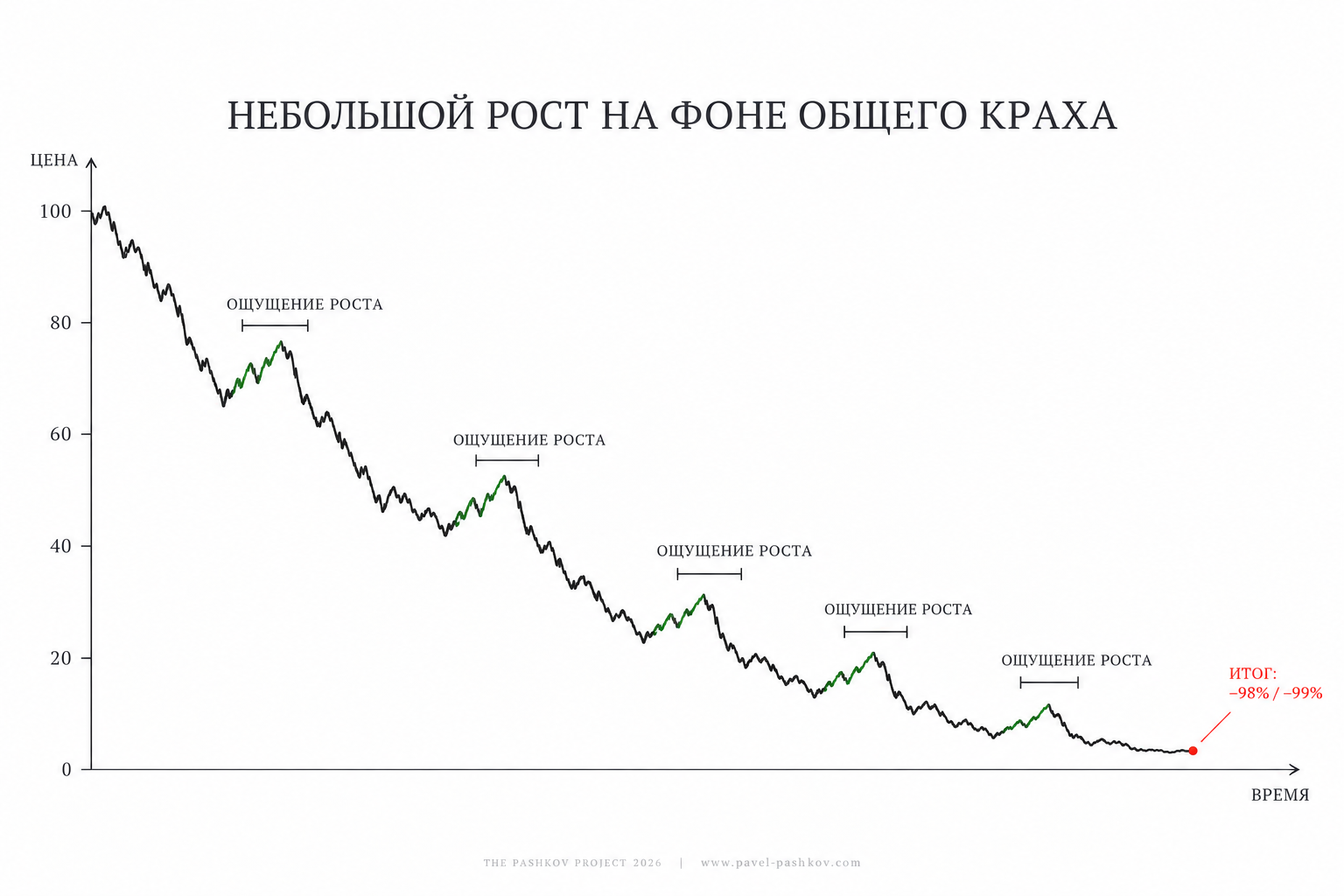
So, people rarely see such charts on a large scale; usually, the observation horizon is very narrow: say, a few months or data from the last year. This is where individual large players profit: since tokens have fallen almost to zero, it's now easier to raise them with small volumes and occasionally lure new players. It's simple: you invest small amounts (nowadays, this is usually done by bots with neural networks on exchanges) and start 'pumping' the token. People tired of losing money see that growth has begun and think that now it will definitely grow by the desired thousands of percent! Liquidity starts to flow into the token, it's 'pumped,' and before the crowd starts to exit, it's crashed again, simply siphoning money from the crowd.
I think the scheme is clear. We are not very interested in the mechanisms of the markets; what is much more intriguing is the behavior of the crowd itself—people do not assess the rate globally. Instead, small surges in volume are enough to consider tokens alive and actively growing! And for this, people give away their last money, investing their savings in the hope: "This time, I'll definitely get mine."
So, in the case of environmental issues, it's completely analogous: almost no one evaluates the problems systematically and historically. Small local surges are enough. We often see news about how they "heroically restored a population" or "saved a species from extinction." We frequently read about how forests were planted by sticking rows of seedlings into the ground, and much more! All of this is perceived positively.
But this is a distortion of perception: nothing is actually improving. Often, actions to "restore forests and populations" pose even greater dangers, as I have mentioned in my previous materials. Wild nature does not need us to go around planting rows of seedlings! It does not need us to open hunting grounds and feed animals in one place, provoking the spread of dangerous diseases and changing the biological behavior of species, creating synanthropic populations.
Nature needs people to leave it alone and stop interfering with the natural processes of the remaining living ecosystems. This is why we propose the implementation of a global project for Territories of Full Ecological Tranquility (TFET)—it is necessary to create enforced wildlife refuges, connect them with ecological corridors for the migration of species and substances, essentially changing the entire existing system of protected areas worldwide.
And when programs to restore individual animal species are launched on the devastated remains of wild nature, where they won't even be able to survive, this is not nature protection at all.
Look. Now I'll visualize it in graphs.
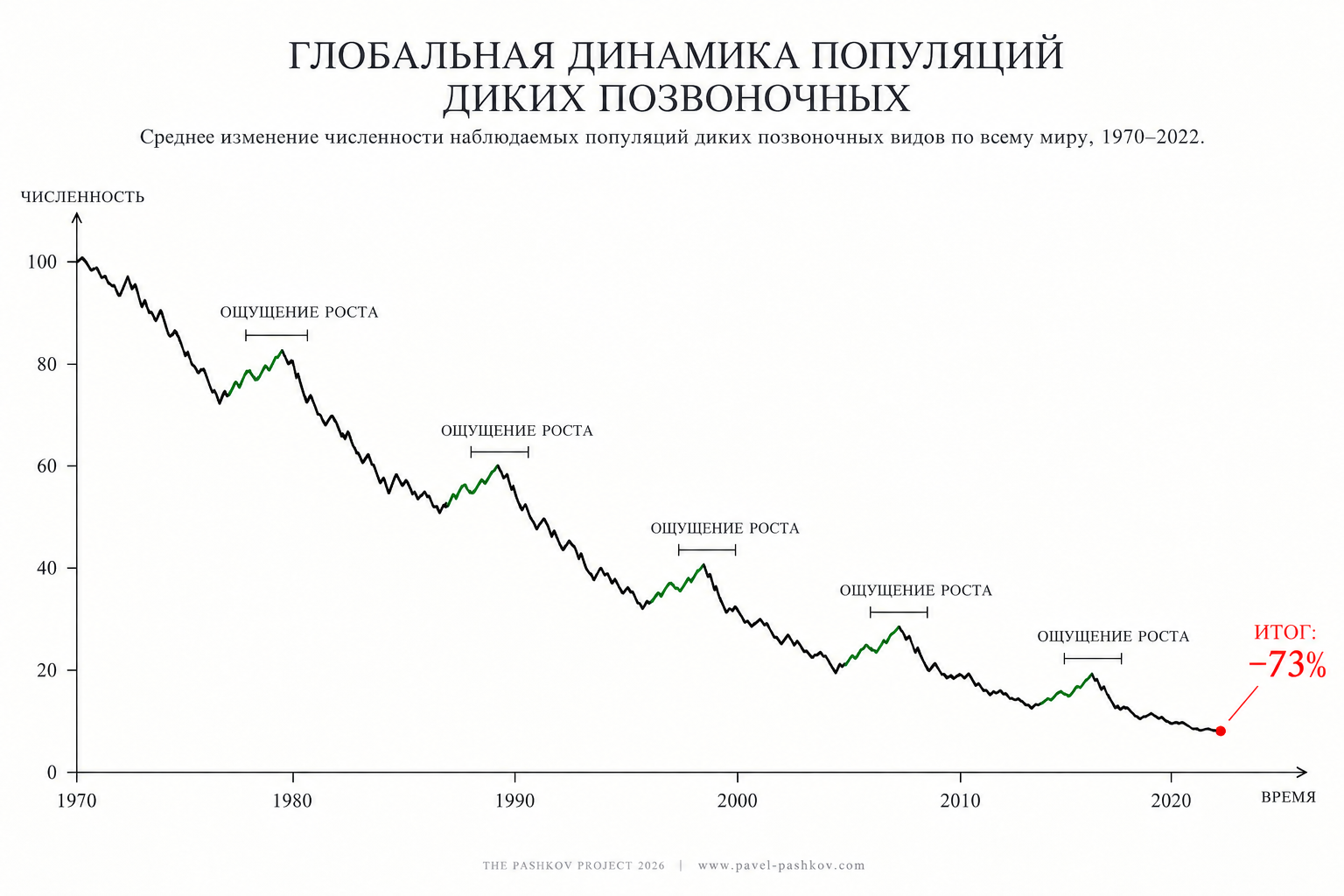
Here you see the most comprehensive meta-analysis by global scientists on the decline in numbers of all observed vertebrate species on the planet. The figures are simply monstrous! In just the last 50 years, from 1970 to 2022, humanity has triggered a mass extinction of animals — numbers have dropped by 73% on average worldwide. In some regions, it reaches 85–90%, while elsewhere the situation is slightly better, but on average — an absolute catastrophe. Researchers analyzed 35,803 population time series covering 5,790 species of mammals, birds, fish, amphibians, and reptiles.
But no one evaluates this on a large scale. Just like in financial markets, people look at a short time horizon, and any minimal spike seems enough to distort their perception of the problem.
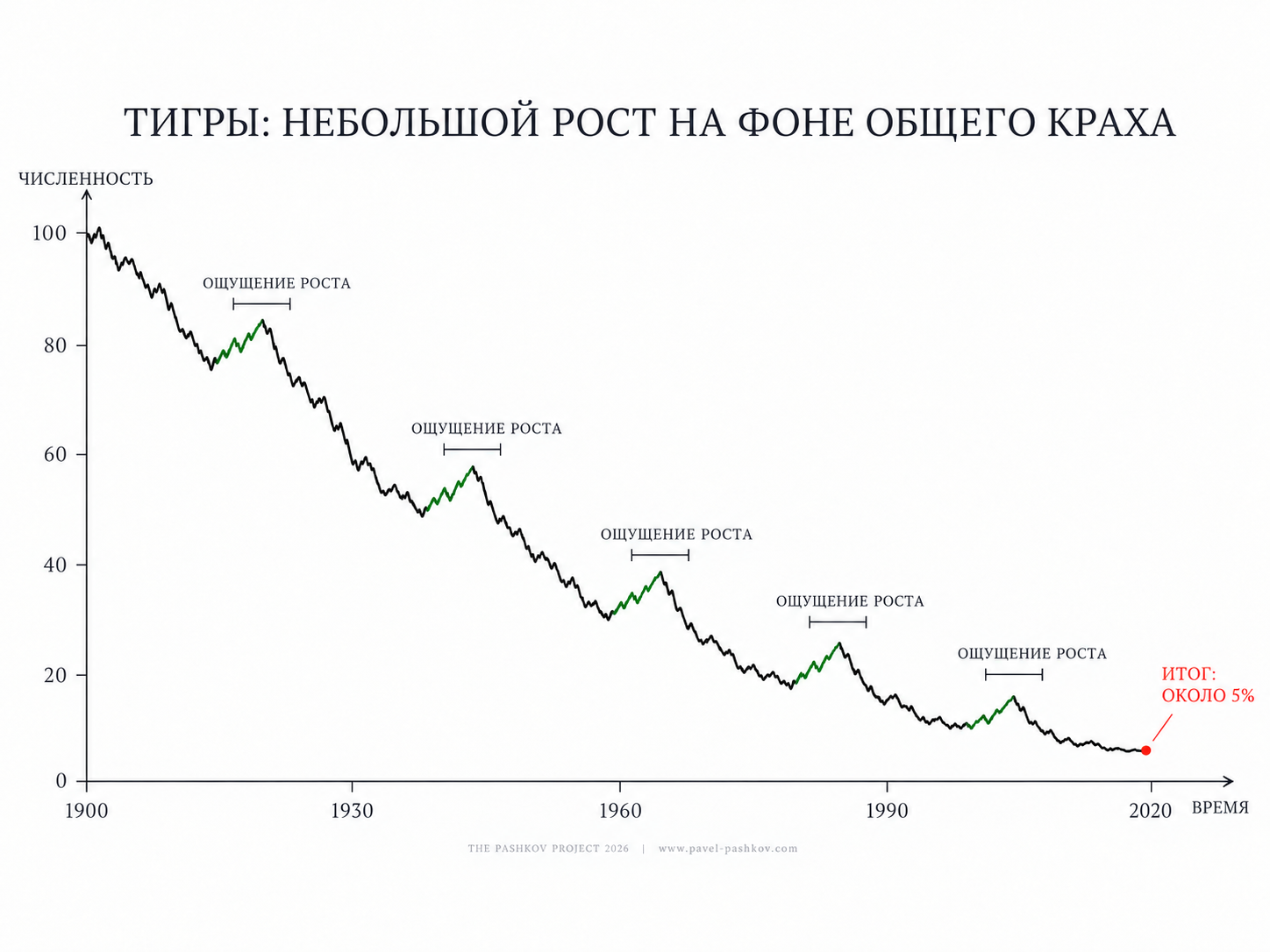
And here you see how the number of tigers has declined over the last 100 years. That is, even at the beginning of the 1900s, despite the lack of proper counting methods, scientists estimate the global population at about 100,000 individuals. This includes our Amur tiger and tigers in other countries.
Now look: by 2010, the number had fallen to just 3,200 individuals worldwide, whereas with modest efforts by the global community, spending millions of dollars annually, the population was restored to approximately 5,700 individuals worldwide by 2025.
So here it is, another spike on the graph, and people around the world think, "It's not so bad, look, the population has almost doubled." This is a true distortion of the problem! Especially against the backdrop of rapidly increasing pressure on ecosystems and even the last reserves, while the hunting lobby worldwide is actively pushing for further killing of endangered tigers.
And I'll show you another graph.
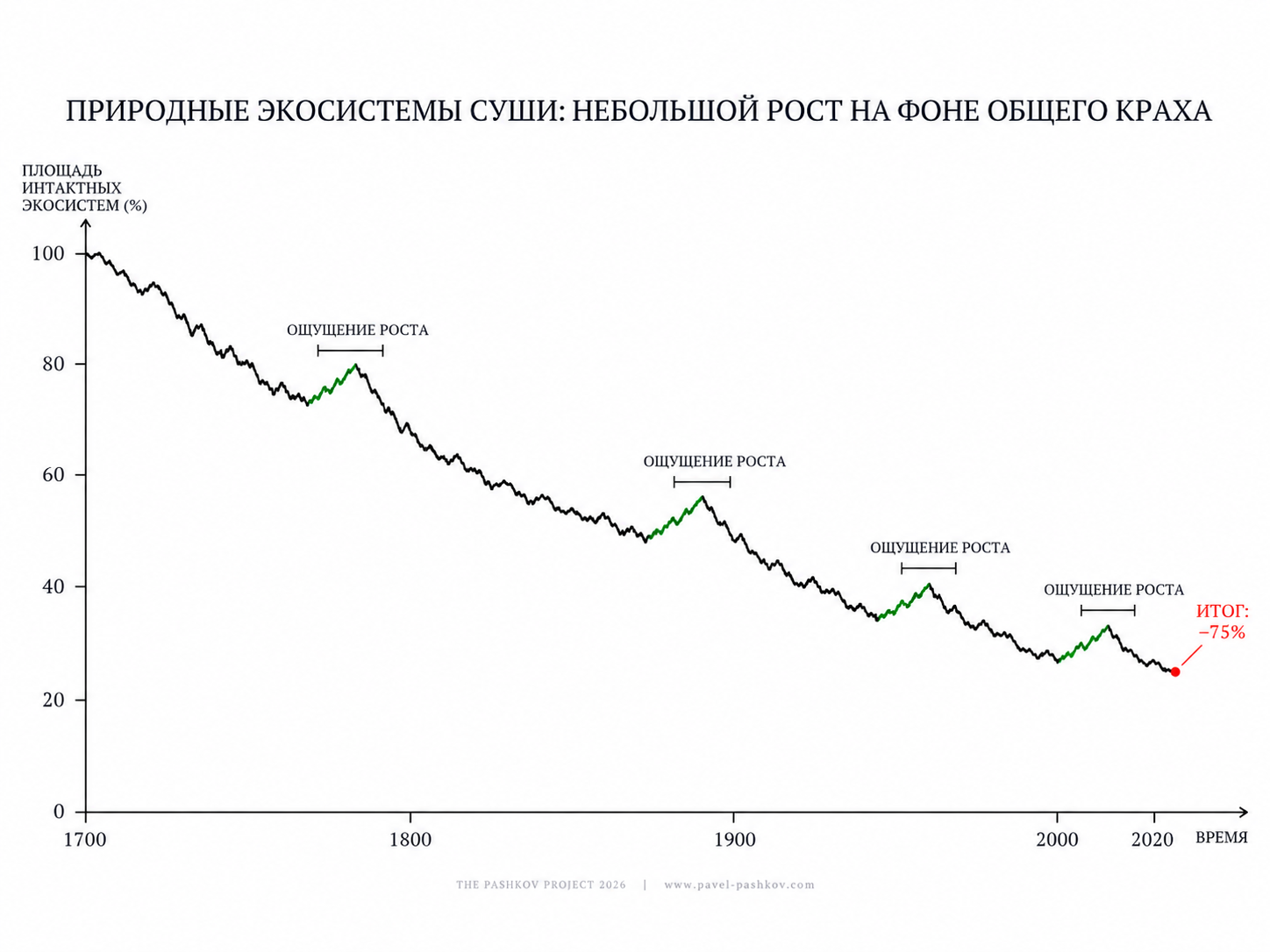
Here, I decided to tackle a deeper issue. The fact is, it's easier to wipe out a species in a short time than to destroy a large, complex ecosystem. It's crucial to scientifically assess the scale of human impact. According to the 2019 assessment by global scientists from IPBES, humans have already significantly altered about 75% of the Earth's land surface. This includes our cities, infrastructure, agriculture, land conversion, and so on.
I am currently studying this in my research. We plan to integrate an interactive map of intact (preserved) natural areas into our projects so that everyone can assess the scale of the Earth's biosphere destruction.
These are the facts.
And our task, comrades, is not just to unite millions of people further, but to explain these difficult things as simply as possible. Every person should be able to quickly grasp the scale of the planetary ecological collapse!
Share this material and continue helping to change the world for the better! The most crucial task now is to awaken people, to trigger an immune response within humanity. If we can unite millions of people beyond political and social boundaries around our struggle, we can direct this enormous force to solve real ecological problems.
Fight for Life!
© PAVEL PASHKOV
Support the fight!
The hardest thing in our time is to remain independent from government and business! All activities are carried out independently. Stand with us and support our Mission to protect wildlife.
I want to support!Get involved
On an ongoing basis, we launch public initiatives together to protect wildlife and achieve real change. Join this work and help change the world for the better.
Explore the initiativesTFET Concept
We are working to transform the global protected-area system — Territories of Full Ecological Tranquility (TFET) must be created. Wildlife needs refuges from human pressure! This is one of the key paths out of the planetary ecological crisis and toward preventing further ecosystem collapse.
Learn more
