
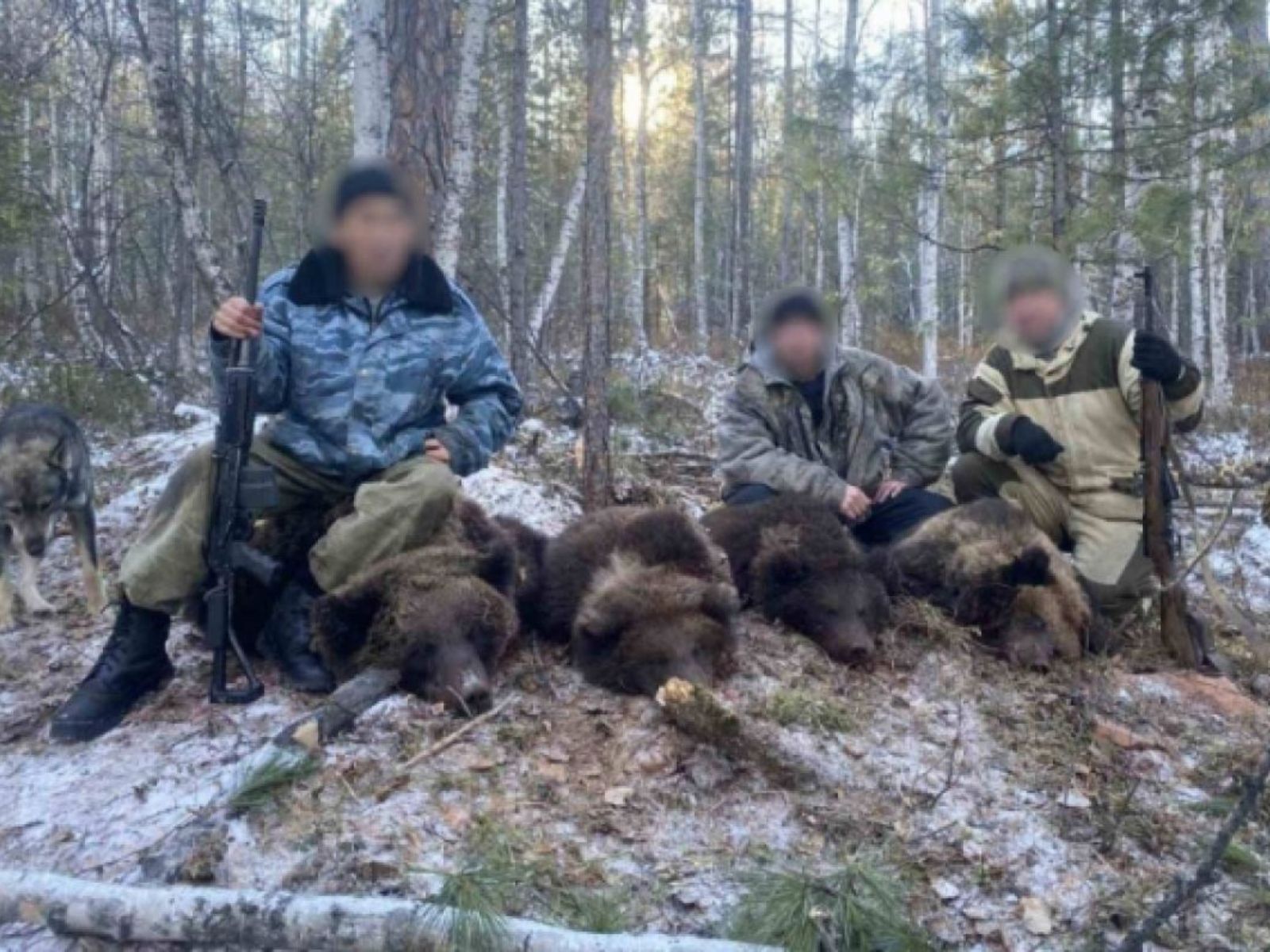
We are told that regulating the numbers of predatory animals is extremely important; otherwise there will be too many of them, and they will “flood everything around.” This is exactly how mass shootings of bears in Russia’s forests are justified, and the extermination of wolves and other animals. Every time it’s the same excuse. It allows not only the pushing of necessary bills in the interests of the hunting lobby in government, but also the “whitewashing” of the extermination of predators with the claim that humans are a super-regulator, the master of nature.
From that viewpoint, killings start to look like noble heroism! In letters, supporters of destroying predatory animals have repeatedly written to me: “without us nature will die, and by killing wolves and bears we are actually saving deer and moose.”
Isn’t that far too much for humans to take upon themselves? So the point, it turns out, is “nobility”? A saving Mission carried out through linear killings?
Today I want to show all our Allies clearly what is actually happening, and how natural regulation of predator populations works. Probably many of our Allies have repeatedly heard phrases like: “if we don’t regulate the number of wolves and bears, there will be so many that they’ll eat all the other animals in the wild, and then only predators and people will remain.”
Well, that is a classic “fear manipulation” that has absolutely no scientific basis. It’s simply outright lying.
When we talk about the future, we can rely only on facts that have already happened. And we do have such cases. I wrote about this earlier: after the Chernobyl nuclear power plant accident, when people were forced to leave the contaminated territory, the animals remained to survive. Over the years, populations recovered; even species that had never been there appeared—essentially, the exclusion zone became a real refugium-shelter for them. So, the number of wolves alone increased многократно—seven times higher than in nearby uncontaminated reserves. The wolves not only did not “eat all the animals,” but also maintain their numbers without sharp growth spikes, leveling and supporting the biological balance of the entire local ecosystem.
In other words, wolf numbers reached the necessary level and then self-maintain at that level. Real scientific data. Moreover, scientists recorded via tracking collars how young lone wolves leave the exclusion zone to search for a mate and build their own families. In this way, the Chernobyl zone has become a point of self-recovery of biological systems, helping to sustain wolf populations even where people уничтожают them.
This is ignored. People don’t even talk about it. And when we send specific scientific papers to officials in federal agencies, they, in their professional bureaucratic manner, hush up this fact.

In general, if we simplify the idea of artificial regulation of numbers, the assumption is that a population is like a water tap, where a person has the right to “turn down” the pressure a little and thereby stabilize the system. But in real ecosystems, large predators are embedded in a network of feedbacks: territoriality, intraspecific competition, diseases, prey availability, the social structure of reproduction, trophic cascades (the classic: predators → herbivores → plants and дальше, what we studied at school), and, of course, engineers of local ecosystems such as beavers, for example. These are all interconnected feedbacks that collapse when predatory animals are exterminated.
No one ever takes this into account in so-called “population control” of animals. Instead, we see linear уничтожение of key predators of the wild with постоянным chaos and conflict.
All the scientific works I studied—and I had to obtain and study dozens of papers by scientists from around the world to understand the problem—point to two facts.
First: under conditions of восстановление of food chains and a reduction of anthropogenic (human) pressure, large predators can quickly recover their populations and self-maintain at a certain level depending on the amount of prey and the integrity of the habitat. This is specifically proven by scientific field studies: no exponential population growth SIMPLY EXISTS.
Second: when humans вмешиваются in the social structure of predators (especially pack animals), an irreversible change in the biology of the population begins—often without a noticeable change in total abundance, but with serious consequences for genetics, behavior, distribution, and conflicts. I mean that in nature, not only the number matters, but also how populations are structured.


Probably one of the most fundamental methodological errors of “regulation” is transferring the logic of agriculture onto a wild food chain. I mean that when people try to “regulate” wildlife, they think as if an ecosystem is устроена like agriculture. Very primitive ideas about the world around us, with serious cognitive distortions.
The point is that a predator typically acts as an external “limiting factor” for herbivore species, and in a living ecosystem it is simultaneously a limiter of prey, an object of limitations from the prey side, and a participant in intraspecific competition. Further, we выделяем it as a “node” for disease transmission and a bearer of spatial structure (territories). These may be difficult things to grasp, so I’ll simplify: THIS IS A COMPLEX BIOLOGICAL SYSTEM that forms the mechanisms of stability of local biogeocenoses, and any interference for “population control” that suddenly seems reasonable and correct to humans destroys all the connections described above.
As for wolves, everything is even more complex. Reproduction in wolf packs is limited by social structure: in a typical pack only a small number of individuals breed, and the size and stability of the entire group determine hunting efficiency and competitiveness. In other words, the family needs to добывать food and hold territory from competitors—simple. But when humans arrive and start destroying wolves, it is not just abundance that changes, but everything: family composition, relatedness, the share of “adopted” unrelated animals, the structure of dispersal, and what is most critical—the STABILITY OF THE PACK.

I studied strong scientific works on this topic by world scientists on eastern wolves: a reduction in killings (after a ban on wolf hunting) led to the restoration of kinship ties at stable density.
When humans arrive with their “regulation,” a cascade of unforeseen negative consequences is triggered. Turnover of individuals and social degradation increase (pack breakdown, regrouping, a growing share of young and inexperienced hunters, and so on). Predictability of interactions with prey and humans worsens!
Let me put it this way: human вмешательство becomes evolutionarily selective. Look: humans often remove animals seemingly хаотично by their availability—for example, near roads, settlements, and so on. These are often, say, hunting wolves, scouts in packs, smart seasoned individuals. And when armed groups follow a wolf’s tracks deep into the wilderness, the goal there is, as a rule, the opposite—“trophy”: consciously find and уничтожить the biggest, strongest wolf, the pack leader, to “get a trophy” for the envy of friends and relatives. That is the main смысл of trophy hunting, isn’t it?
That is evolutionarily selective intervention: when mortality is natural in the wild, individuals with strong genes, hardy, smart, survive—the very natural selection. Today, the source of selection is the human being, who, on the contrary, destroys the strongest and best individuals, leaving sick and weak wolves for further breeding. Genetic changes begin that affect all the other populations!
Now let’s discuss how self-regulation mechanisms work in healthy ecosystems.
Everything is simple: within biological systems, everything is arranged so that populations can удерживаться within the needed range of numbers through internal and network feedbacks. As I said earlier, this is determined by resources, risks, and habitat. For example, during fieldwork in national parks, scientists repeatedly recorded a sharp increase in wolf numbers, then a peak, and then a long period of lower numbers, which they associate with сокращение of prey and diseases.
In scientific terminology this is called “density-dependent mortality.” It happens through several channels. The first is resource-based: when prey is low, territories expand, predator density falls, and juvenile survival declines. The second channel is behavioral and spatial: territoriality, intraspecific competition, and social rules of reproduction. For wolves, a key mechanism is inter-pack conflicts and protection of the space where offspring are raised; in field observations, attacks on dens led to adult deaths and the loss of pups, and sometimes to the прекращение of a pack’s existence and the loss of territory.
I try to speak in a simplified way so it’s easier to understand. Essentially, these are rules formed by evolutionary history: over thousands of years the logic of territoriality was built—high density increases competition, competition increases mortality and decreases reproductive success, which stabilizes the entire system.
Another channel is diseases and parasites—these are density-dependent “brakes.” I think it’s a good term. Again, I studied scientific works on national parks: scientists observed recurring outbreaks of canine distemper virus with a sharp decline in pup survival in outbreak years and a high, almost “enzootic” exposure to a number of other pathogens; and the conclusion of the studies is that diseases can cause short-term declines in abundance and modulate “regulation.”
I’ll simplify: the higher the density or the closer the contacts within a population (exactly when numbers are high), the easier infections spread and the stronger their demographic effect. This is BUILT INTO NATURE. Growth in numbers increases the risk of outbreaks, which leads to a reduction in numbers.
With tiger populations the story is exactly the same, but with a difference in social structure, and big cats are одиночки. In tigers, self-regulation is read through the link between density and prey, and through territoriality.
With bears it’s even more interesting. I studied very good research several years ago. The point is that large bears are, above all, a classic example of a species with a slow life history. Late maturation, intervals between litters, a high cost of female death. This makes populations biologically “self-regulated” in their growth rate: even under good conditions they cannot “explode” in numbers the way small omnivores or rodents do, and when mortality rises they quickly go into decline. That’s why any statements by officials about “excessively growing bear numbers” puzzle me—I look at officials’ reports and at real scientific data. It doesn’t match. Nothing matches at all. It’s as if we live in different parallel worlds with these bureaucrats.
Here is, in fact, a study by Japanese scientists who for many years studied brown bears in the Rusha area on the Shiretoko Peninsula. In 2006–2016, there were 15 females there capable of producing offspring. The scientists assessed reproduction parameters and cub survival. As you understand, since it is a peninsula, the territorial factor is extremely important. Most cub disappearances occurred in July–August, which the scientists interpret as linking juvenile mortality to food and summer conditions. This is resource-based regulation of abundance.
This can be complemented by an independent work on Hokkaido, where after conflict shootings (if a mother bear came out to people and she was killed), scientists studied the reproductive tracts of females. The study presents data directly on the difference between ovulation, implantation, and the actual litter size, including annual variation. A direct correlation with dependence on stress, animal condition, and nutrition. Put simply, PHYSIOLOGICALLY the animals could not produce normal offspring if there were disturbances in biological systems.
I will sum up.
This material can and should be made EVEN MORE and MORE DETAILED. But I think for a narrow topic it is enough. In reality, population control can be justified ONLY for invasive alien species that enter or were deliberately introduced into ecosystems. But in a natural habitat, no “regulation” of native species is required—nature and evolution have already taken care of everything themselves. PEOPLE ARE NOT NEEDED THERE AT ALL.
And do you know what the black irony is? The only predator that has truly learned to bypass any natural regulators and to deliver a colossal удар to all biological systems on the planet is humans themselves. We have indeed built sanitary barriers against natural infections, reduced mortality of our own population, started systematically extending life, and turned technology into an equivalent of a resource that allows us to “push apart” ecological carrying capacity. I think I expressed it clearly!
I’m not trying to appeal to “fair/unfair” here; I’m talking about factual demography: the world human population reached 8 billion people in November 2022 and, according to UN projections, will continue to grow for decades, approaching a peak around the mid-2080s.
And our difference from wild animals is that in nature large predators pay for population growth immediately: territory compresses, competition hits survival, diseases “mow down” juveniles, there is no prey—and numbers INEVITABLY return back to the required and permissible range. But for humans, the feedbacks that do exist (resources, climatic and ecological limits, social conflicts) strike not one group but the entire planetary infrastructure—our whole biosphere. And this delivers a colossal удар to all life on Earth, сокращая and destroying the last habitat of wild animals, first of all.
After that, people still have the audacity to say something about “population control” of animals.
© PAVEL PASHKOV
Support the fight!
The hardest thing in our time is to remain independent from government and business! All activities are carried out independently. Stand with us and support our Mission to protect wildlife.
I want to support!Get involved
On an ongoing basis, we launch public initiatives together to protect wildlife and achieve real change. Join this work and help change the world for the better.
Explore the initiativesTFET Concept
We are working to transform the global protected-area system — Territories of Full Ecological Tranquility (TFET) must be created. Wildlife needs refuges from human pressure! This is one of the key paths out of the planetary ecological crisis and toward preventing further ecosystem collapse.
Learn more
