What humanity is doing right now is the outright destruction of the planet’s biosphere — our own habitat. We are destroying millions of years of evolutionary history, and, unfortunately, now that the Fourth Industrial Revolution has begun, people have accelerated the destruction of wild nature. At this point, we are talking about the destruction of the last remaining natural ecosystems — the very refuges that must never, under any circumstances, be disturbed.
We are witnessing utterly criminal bills being adopted by governments in different countries in attempts to lower the protected status of existing, already fragmented protected areas. It is especially alarming that the overwhelming majority of people do not understand this and do not even reflect on the scale of the ongoing destruction of nature. Yet the logic here is simple: this is our own home, our small green planet. If we destroy it, we will perish as well. We depend on every process taking place in Earth’s biosphere.
But how can one understand the scale of the catastrophe? How can an ordinary person assess the seriousness of what is happening?
Scientists around the world have identified special red lines that must never be crossed. This is called the “Planetary Boundaries Framework” — it was first proposed in 2009 as a scientific framework limiting anthropogenic pressure (that is, human activity) on key global processes. The concept quickly gained support from scientists and experts worldwide, after which it was expanded twice. Today, planetary boundaries are the primary scientifically measurable indicator of the catastrophic impact humanity is having on the entire biosphere of Earth.
It is very simple: planetary boundaries define the lines that must not be crossed. There are nine such boundaries in total, and if all of them are breached, life on the planet will become impossible. That would mean the destruction of our habitat.
According to the latest assessments, humanity has already breached seven of the nine planetary boundaries. These data were published by scientists in the meta-report “Planetary Health Check 2025” last year. In other words, humanity has only just crossed yet another red line, and now only two steps remain before all planetary processes of Earth are disrupted.
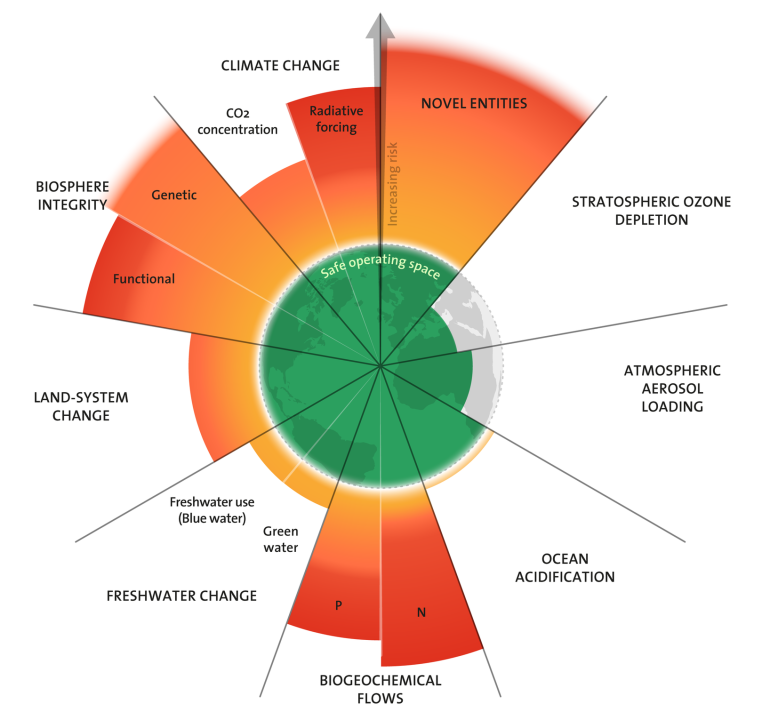
Now let me explain in more detail what these boundaries actually are.
Climate.
The planet’s systems depend heavily on climatic regimes. Remember how I spoke about the remarkable scientific works of our Russian physicists on the biotic regulation of climate by ancient forests? Well, people are cutting those forests down, the biotic pump stops functioning, and the planet begins to fail. Along with the release of enormous masses of carbon dioxide once held back by old-growth forests, this triggers droughts, the depletion of water tables, and anomalous wildfires. Thus, the first planetary boundary is based on planetary overheating — and today we have crossed the boundary of the safe level.
Biodiversity.
I have spoken about this as well: according to the latest scientific data, the abundance of all animals on the planet has declined by 73% over the past 50 years, meaning that only about 27% of living species remain. Plants are disappearing too, and even trees — we are talking about genetic “erasure” from the face of the planet itself. For example, every third tree species is at risk of extinction.
Thus, the second planetary boundary is based on indicators showing that the living world is being destroyed faster than it can recover. Species are disappearing many times faster than any natural background rate. Even if we take global catastrophes of the past into account, they do not compare with human impact. And the fewer species remain, the weaker forests, soils, rivers, seas, and the entire system of life on the planet become. This boundary has already been breached.
Land-System Change.
Humanity is reshaping the face of the planet for its own purposes. Forests are cut down, steppes are ploughed up, wetlands are drained, and natural territories are converted into agricultural land, cities, roads, and industrial zones. In other words, true wild nature and natural biological systems are being replaced by a uniform economic landscape. This leads not only to accelerated species extinction, but also to the disruption of vital processes: ecosystems lose their ability to retain water, cool the climate, protect soils, and maintain nutrient cycling. This boundary has also been breached.
Freshwater.
In early scientific work, researchers looked in a primitive way only at how much water humans withdraw from rivers, lakes, and underground sources. This distorted reality. In the latest studies, global experts show a broader dynamic: we have already disrupted river water, soil moisture, and, more broadly, the entire water regime on land. Water is no longer distributed as it was arranged and maintained in true wild nature. That is why we now see abnormal droughts and scorched lands in some places, and massive floods in others. This planetary boundary has been breached.
Biogeochemical Cycles of Nitrogen and Phosphorus.
This planetary boundary concerns fertilizers and intensive agriculture. Humans are adding too much nitrogen and phosphorus to nature, and all of this, together with surface waters, flows into rivers, lakes, and seas. Yes, these are natural substances, but when they are spread in global quantities over “millions upon millions” of fields, it becomes a catastrophe.
Water begins to bloom, oxygen levels decline, dead zones emerge, fish suffer, and entire ecosystems — from terrestrial to marine — slowly degrade. Agriculture must be grown every year, so the problem has become chronic and cyclical. In essence, we have interfered with the planet’s natural chemistry and overloaded it with nutrients to such an extent that we ourselves are no longer capable of stopping. This boundary has also been breached.
Atmospheric Aerosol Pollution.
This refers to fine particles in the air — soot, dust, industrial emissions, and other aerosols. All of these aerosols strike a devastating blow not only to wild nature, but also to humanity itself. People begin dying from cancer, deadly respiratory diseases emerge, and aerosols also affect climatic processes, surprisingly enough — for example, precipitation patterns and monsoons. This boundary has not yet been fully breached.
Ocean Acidification.
Put very simply: when too much carbon dioxide is emitted into the air, the ocean begins to absorb part of this excess, and as a result the water shifts chemically in a more acidic direction. It does not become an acid in the everyday sense of the word; rather, its alkalinity decreases, and that alone is enough to trigger global problems for marine organisms.
The problem is that many organisms need carbonate minerals to build shells and skeletons. When the ocean acidifies, such species become unable to form and maintain hard structures. This is where the collapse of corals, oysters, mollusks, and other organisms begins, and in turn entire marine ecosystems die along the chain. Food webs simply collapse.
It has been scientifically proven that it is primarily human emissions that drive this alteration in “ocean chemistry,” and this undermines one of the fundamental systems of life on the planet. In the scientists’ updated report, this boundary has been breached.
Stratospheric Ozone.
This is the very red line that probably everyone has heard of — the destruction of the ozone layer. And this is entirely true: certain chemicals released through human activity did indeed affect stratospheric ozone. Today this planetary boundary remains within the safe zone, but everything can change at any moment.
Novel Entities.
The final planetary boundary concerns everything humanity has created and then began adding on a mass scale to the biosphere, which is evolutionarily completely unadapted to it. We are talking about microplastics, synthetic chemicals, pesticides, persistent pollutants, certain industrial compounds, and so on. And there are only more and more of these substances, while no one is in a hurry to control their release — as you can see, states are busy redistributing power and money, with no time to care about life on Earth.
At present, planetary pollution with artificial substances is occurring on a colossal scale and with extreme — indeed catastrophic — speed. This boundary is also considered exceeded; it has already been breached by humanity.
Those are the nine planetary boundaries. According to scientists’ data for 2025, the following boundaries have been breached: climate, biosphere integrity (biodiversity), land-system change, freshwater, biogeochemical flows of nitrogen and phosphorus, as well as novel entities. Meanwhile, stratospheric ozone and atmospheric aerosol loading still remain in the safe zone for now.
In essence, one could say that humanity is now “consuming the last remaining reserves,” and the only thing that is still more or less functioning normally is the ability to breathe. Only about 27% of animals remain, everything is polluted and poisoned, and instead of seeking possible solutions, we are now witnessing a race among states to seize the last refuges of wild nature.
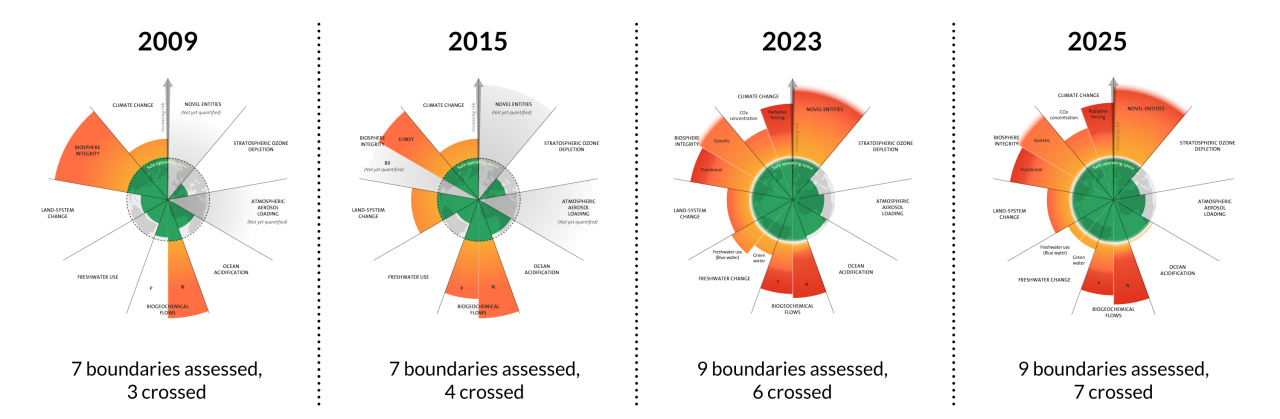
The seventh breached boundary has only just crossed the threshold. Now let me show you how the dynamics of planetary boundaries have changed, so that you can understand how rapidly Earth’s biosphere is being destroyed.
This chart was prepared by the scientists themselves, so you can roughly assess the scale of the problem. Just a few years — and the limits have changed like this.
All of this is an enormous and grave catastrophe. A planetary catastrophe that directly affects our lives and will affect the lives of our children even more severely.
What will happen if the planetary boundaries are fully breached and their limits reach their peak? Look at the graphs — some of the red zones are colossal, almost completely covering the approximate “impact” areas.
If all the zones reach such positions, life on the planet will simply become impossible. But for now, this can still be corrected. For that, all states must act, the existing protected-area system must be changed, and we, together with our Allies, are proposing a concrete solution — a way out of the current planetary crisis: the creation of the Territories of Full Ecological Tranquility (TFET).
The world must hear us. Our Mission in the struggle for Life is what is truly important and necessary for all humankind.
© PAVEL PASHKOV
Support the fight!
The hardest thing in our time is to remain independent from government and business! All activities are carried out independently. Stand with us and support our Mission to protect wildlife.
I want to support!Get involved
On an ongoing basis, we launch public initiatives together to protect wildlife and achieve real change. Join this work and help change the world for the better.
Explore the initiativesTFET Concept
We are working to transform the global protected-area system — Territories of Full Ecological Tranquility (TFET) must be created. Wildlife needs refuges from human pressure! This is one of the key paths out of the planetary ecological crisis and toward preventing further ecosystem collapse.
Learn more
