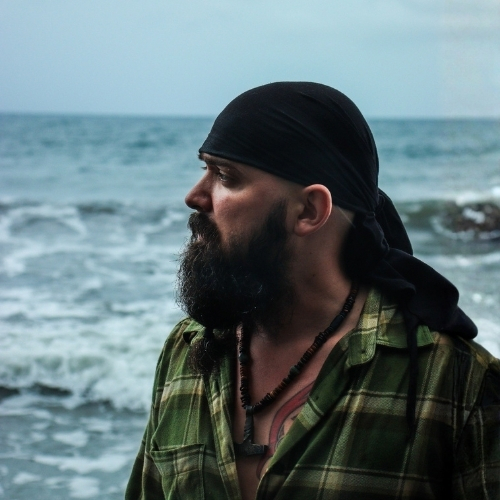
In fact, our mind, our own “I”, personality, self-awareness, stands on the foundation of perception.
On the foundation of the sense organs: the eyes see, the ears hear, the sense of smell distinguishes odors, the tongue distinguishes tastes, and the skin receptors of touch and tactility allow us to sense the world literally with the whole body, to “feel it with our skin”.
Simple, banal, and sooo boring?!
It would seem so. But…
…but I am beginning to understand more and more that the people around me are losing the complexity and depth of their perception of the surrounding world. They do not notice the variety of colors that I distinguish. They do not hear the sounds that I hear. They do not understand at all how one can see tracks in the grass.
It is very similar to hearing people speak a foreign language you do not know. You hear the sounds, but that incomprehensible murmur does not break down into words and phrases for you, and the meaning of those sounds remains inaccessible.
When I was a child, I read adventure novels. I admired trackers who were able, quite literally, to see tracks in the air.
Even now I remember certain vivid episodes, for example from James Fenimore Cooper’s novel The Deerslayer. In it, the hunter and tracker Natty Bumppo — also known as Deerslayer, Hawkeye, and Leatherstocking — demonstrates a perfect knowledge of the laws of the forest, respect for animal life — he does not kill for amusement — and a moral code that is often higher than the laws of so-called “civilized white people”.
Or the books by the writer and explorer Vladimir Arsenyev, Across the Ussuri Kray and Dersu Uzala, which describe his expeditions through the Ussuri taiga together with his friend and guide, the Goldi man Dersu Uzala. Moreover, Dersu Uzala was a real person, whose extraordinary ability to hear and understand the voice of the taiga Arsenyev described in his books.
And now I sometimes feel like this kind of “Hawkeye Indian” when communicating with other people: they completely fail to notice what is obvious to me in the taiga.
People do talk about these subjects, about the loss of depth in the perception of the surrounding world, but they talk about them too little. This subject has not been reflected upon by society, not understood to a sufficient degree. Yes, just the other day — in 2026 — I saw a new study in which a graph showed the decline in people’s intelligence levels coinciding with the time when smartphones became widespread. But I do not think this is a cause-and-effect relationship. The issue is not smartphones. More precisely, it is not only and not so much smartphones as a whole complex of factors in the changed way people live. A systemic shift, precisely in the loss of depth of perception of the surrounding world.
Two factors:
First,
the narrowing of the sensory channels of perception.
We communicate with other people in person less and less. We do not hear their voices except through electronic processing. Yes, yes, do not be surprised if you have never thought about this before! The sound of a voice over the phone is far from equal in complexity to a live voice! It is, as it were, “cut down”, much simpler. And yes, the smell of the person you are speaking to is not transmitted by phone at all.
We spend less time in nature, cutting off a simply enormous mass of sensory information here as well.
We replace the complex living world with simplified electronic models of that world wherever we can, without any real need to do so.
Second,
ultra-strong stimuli, overstimulation, which literally “clogs” our sense organs physically.
Just imagine: if someone shouts into a megaphone directly into your ear, you will go deaf. You can physically test this — the first time, you will go deaf temporarily; nothing too terrible.
But workers employed in noisy industrial environments develop hearing loss as an occupational disease. They hear poorly forever.
In the same way, all of us suffer from this kind of “occupational disease of civilized people”:
— food without artificial flavor enhancers seems “bland”, “tasteless” to us;
— we see poorly outdoors, in natural light, having “ruined” our eyesight with computer and smartphone screens;
— our ear loses the ability to distinguish the sounds of nature, suppressed by the constant noise of the city.
I wrote this material:
“When you enter wild nature, you must hear Life. If you do not hear it, then the nature around you is dying. It means something is wrong.
Listen, learn tactility with nature, learn sensations. Close your eyes. Feel the birdsong, the wind. Feel yourself as part of this world.”
In my opinion, it turned out to be a very strong text! I gave it to acquaintances to read. And the first readers asked me: “Uh… but how exactly?! We do not understand how to do this! Explain in more detail!”
And it begins to dawn on me just HOW MASSIVE the loss of sharpness in the perception of the living world has become in society!
If until quite recently this was natural, now it has to be taught. Just as after the revolution there were literacy courses — the liquidation of illiteracy. So now it may be time to create courses for the literacy of Life and teach people to hear the voice of nature, to hear the voice of the Living World around them.
What is to be done with nature-study lessons at school, if until quite recently a child came to school after having already run barefoot through the grass, picked wild strawberries, and caught frogs, while now children have never come into contact with these elements of living nature at all, in any way? In other words, physical familiarity with the living world used to be assumed by default. It was common experience! And nature study in primary school taught children to systematize and classify objects that were physically understandable and already known to them.
But now it is necessary first to give children the experience of physical interaction with objects of the real world; otherwise, from the very beginning, the child will not understand what exactly he or she is studying.
It is like building a pyramid out of blocks — it teaches an understanding of how blocks can be placed and how they will collapse. It teaches the physical sense of the real world. An irreplaceable experience, in no way identical to drawing pyramids of blocks on a computer screen!
Look, this loss of sharpness and depth of perception that is now taking place is:
— mass-scale, happening to all people simultaneously;
— lightning-fast, occurring at enormous speed over the last few decades; this is how phase transitions occur in nature, for example water–ice or water–steam, when fundamental properties change;
— not recognized by society: the rules of the game have already changed, while we are still continuing to play by outdated rules.
The first step toward solving any problem is to become aware of that problem. We ourselves are losing the sharpness of our perception of the surrounding world, but we can become aware of this and trace it within ourselves. We have experience of contact with the real world. Our children often do not even receive the experience of physical contact with the surrounding world in the volume that we received.
What should be done? Does this matter at all, or not? Should children learn to distinguish birdsong, or should merchants be allowed to privatize the last nature reserves as hunting grounds and tourist clusters and “rake in the cash” as much as they want from the destruction of nature, while all birds are poisoned as “feathered pests” so that they no longer chirp at all, as was done in China during the “campaign against sparrows” by decree of the Great Helmsman Mao?
© PAVEL PASHKOV
Support the fight!
The hardest thing in our time is to remain independent from government and business! All activities are carried out independently. Stand with us and support our Mission to protect wildlife.
I want to support!Get involved
On an ongoing basis, we launch public initiatives together to protect wildlife and achieve real change. Join this work and help change the world for the better.
Explore the initiativesTFET Concept
We are working to transform the global protected-area system — Territories of Full Ecological Tranquility (TFET) must be created. Wildlife needs refuges from human pressure! This is one of the key paths out of the planetary ecological crisis and toward preventing further ecosystem collapse.
Learn more
