When people talk about the scale of environmental problems in the world, they most often focus on the size of a country. And in the context of our country, this creates an absolute illusion of Russia’s resilience in the face of any problems. I think all of our supporters have heard this many times: in such a large country, it is impossible to destroy nature, impossible to cut down the forests, and so on.
But this is a distortion of perception. Our planet is small, and not a single part of it, not a single territory, has remained untouched. We destroy absolutely everything we come into contact with. And even places that humans still cannot physically reach, such as remote regions of the Arctic or Antarctica, are reached by hazardous chemical substances circulating with precipitation in the form of micro- and nanoplastic particles, as well as forever chemicals.
No, the large size of a country will not protect it from environmental problems. And no, the principle that “a large territory and a low population do not threaten nature” does not work here.
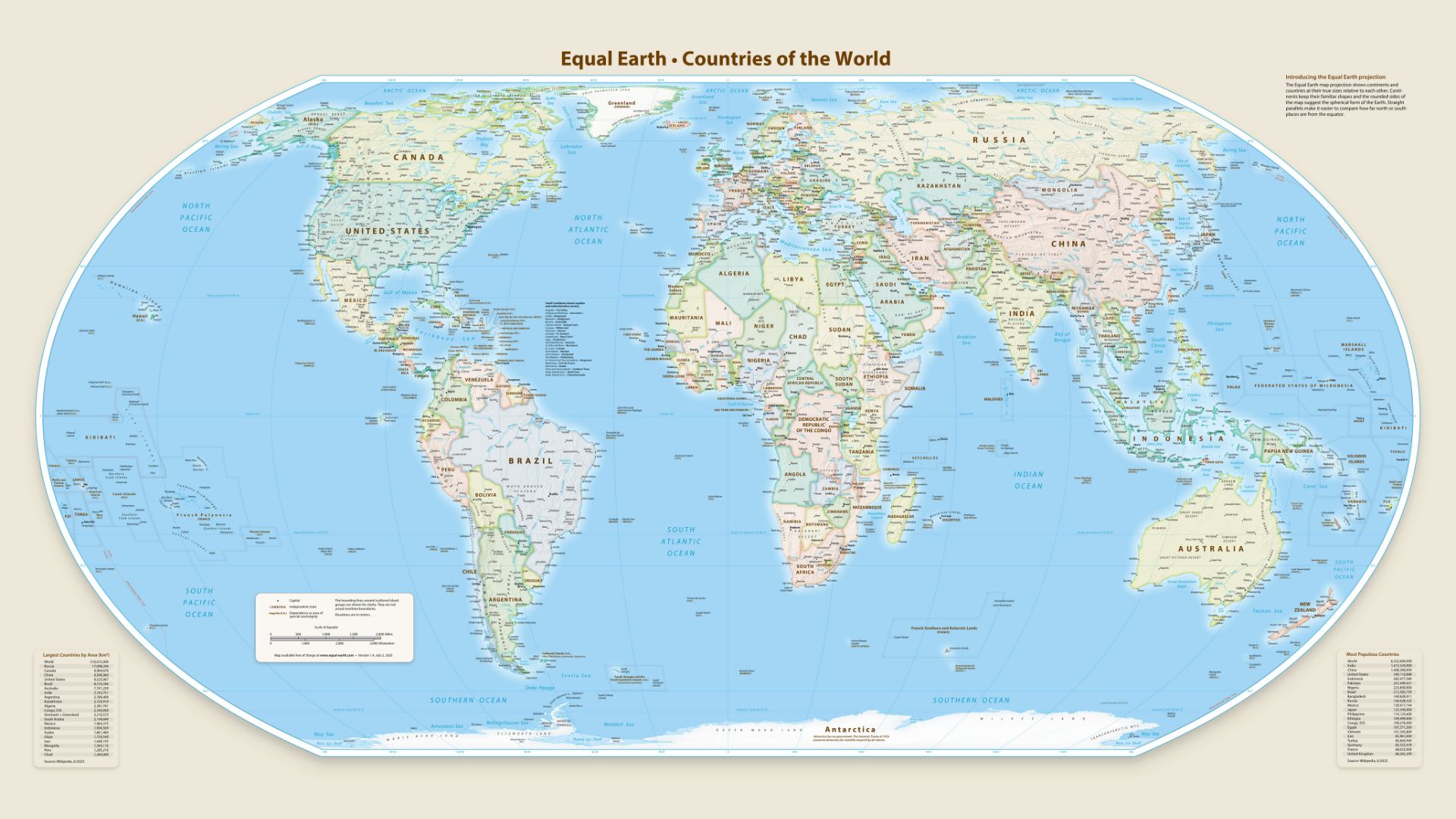
I want to talk now about the following. Just recently, on September 4, 2026, the UN General Assembly supported resolution A/80/L.104, “Correct the Map,” calling for the relative regions of the world to be shown correctly using true equal-area map projections. 164 countries voted in favor of the resolution, the United States voted against it, and six countries abstained.
To put it simply, it means this: the world map should now display the actual territories of countries in proportion to their real area on Earth.
I have previously written a great deal and studied environmental problems in Australia. In just a couple of centuries, they literally destroyed entire ecosystems there, wiped out species, and introduced an enormous number of invasive animal species. And now, every year, they carry out mass slaughter to destroy animals whose populations have multiplied. They shoot feral horses, camels, dingoes, organize the mass killing of millions of kangaroos, and much more. Australia is one of the clearest examples of just how severely humans can destroy ecosystems that had remained stable for thousands of years within a short period of time, bringing an entire continent to collapse.
But what does Australia look like on the map we are accustomed to? A large “island” somewhere far away from us. And when people look at the world map, they conclude: “Yes, apparently an island can be destroyed, devastated, and its species wiped out. But look at Russia — an enormous country, gigantic; surely this could never happen here.” Many people even laughed at the idea of calling an island a continent.
But it is a continent. Huge and unique. Look: according to UN data, Russia’s actual area is 17 098 246 km², while Australia’s is 7 692 024 km². Thus, in reality, our country is the size of 2.2 Australias.
But because everything looks different on the world map, this intuitively reinforces the mistaken idea that “there is simply too much land and forest for them to be seriously depleted.”
The old map we are accustomed to is the Mercator projection, which appeared in the 16th century as a navigation tool so that sailors could plot a constant course in a straight line. In other words, it would be wrong to say that the projection itself was erroneous or somehow incorrect, because that is not the case — it was simply designed for completely different purposes. Only later did this navigation tool begin to be used as a neutral representation, so to speak, of the relative sizes of continents and countries.
And now, according to the Equal Earth map, it is proposed that the area of territories should be represented correctly. Roughly speaking, with the previous map everything came down to the fact that the Earth is round while the map is flat — therefore, it was impossible to show the Earth on a flat sheet without distortion. But the new projection is designed specifically to represent the area of territories correctly. For example, if Russia is approximately twice the size of another country by area, then it will also occupy approximately twice as much area on the map. In other words, countries do not appear artificially enormous or excessively small merely because of their position on Earth.
But there is a price to pay for such a solution, because the shapes of continents may be slightly stretched or compressed, while distances and angles will not be accurate everywhere. In return, however, it becomes possible to assess the real size of countries on the world map.
Russia and Australia are a good example, because one country lies predominantly in the high latitudes of the Northern Hemisphere, while the other is much closer to the equatorial and middle latitudes. Therefore, the Mercator projection visually exaggerates the difference between them. When we look at the old map and imagine Australia, it seems to us that Russia is at least five or even six times larger! And when we overlay environmental problems and the scale of ecological collapse onto this perception, we compare it with our own country and think: “No, surely we still have plenty of resilience left.”
Moreover, if we talk about population, Australia had 27.8 million people as of December 31, 2025, while Russia had 146.1 million people as of January 1, 2025. In other words, Russia’s population is approximately 5.2 times larger than Australia’s. To put it even more clearly, Russia has about 8.5 people per 1 km², while Australia has about 3.6 people per 1 km². In other words, our population density is approximately 2.36 times higher than Australia’s.
I think this gives a good idea of how perception becomes distorted when we compare countries, population size, and the possibility of ending up in an environmental collapse. Obviously, this is purely a mathematical model, because in reality both Russia and especially Australia are populated extremely unevenly: vast territories are almost uninhabited, while the population is concentrated in cities and individual regions. But the general model still allows us to rely on real data in order to understand the scale and the potential scale of pressure on wildlife.
I have previously written a great deal about the situation in Australia because I studied the environmental collapse on the continent. Many specialists call Australia a “testing ground for global ecocide,” and this is entirely justified. It is one of the clearest examples in the world of an anthropogenically created environmental crisis, where the consequences of the mass introduction of alien species are now being addressed through equally massive lethal control of animals. The same cycle of killing that I mentioned earlier.
After the beginning of European colonization in 1788, the rate of biological introductions began to increase catastrophically: thousands of alien organisms that had never existed there became established in Australia. For example, I came across data from a peer-reviewed paper in Biological Conservation in which scientists counted 100 recognized extinct endemic Australian species since 1788. In just a couple of centuries, more than 100 links in biological systems became extinct — that is it, they disappeared, simply erased from the face of the Earth forever. They are gone. Mammals were particularly severely affected.
It is very simple. For example, European rabbits were introduced here in 1859 and spread across the entire continent. Foxes were also introduced, and they colonized most of the territory. Domestic cats found the conditions especially comfortable — today they have become feral and inhabit 99.9% of Australia’s land area. Despite all of these actions, people did not stop and continued their experiments with spreading invasive species: in 1935, an official government body deliberately released 2 400 cane toads without even properly assessing their ecological consequences beforehand, and now they are everywhere.
Now, EVERY YEAR, the authorities spend public money simply to shoot animals across the entire continent. Look at just the most recent years:
July 2024 — March 2025, New South Wales: the authorities launched an aerial animal shooting program. At least 53 thousand feral pigs + 8 654 deer and other animals were killed from helicopters.
Just recently, in the northwest of the country (2026), 7 023 pigs, 4 664 goats, 603 deer, 243 horses, 58 cats, 37 foxes, 9 wild dogs, 2 donkeys, and 1 camel were shot from the air.
By June 30, 2026, 6 673 horses officially recorded as having been shot and killed from helicopters had been registered, as well as at least another 1 156 killed from the ground.
From 2022 through 2026, an annual government “conservation cull” program has been ongoing. If officially recorded independent animals and joeys in pouches are counted together, around 14 350 kangaroos were killed between 2022 and 2026, along with an additional 344 wallabies and 156 of their young. In total, according to the published data I found, this amounts to about 14 850 animals. And here we are no longer talking about killing invasive animal species, but native ones that inhabited the continent long before humans appeared.
In April 2025, koalas were shot from helicopters in a national park after wildfires, with more than a thousand koalas killed. And this is also a native species of the continent! The authorities justified this by claiming that it was supposedly not a shooting operation but “aerial euthanasia”: of 2 219 animals assessed, 48% were considered severely burned/injured and in need of euthanasia. Well, essentially, they simply flew around in helicopters and shot animals that had survived the wildfires with sniper rifles! Absolute madness: wildlife defenders in Australia and specialist scientists and experts opposed this.
And in Queensland, during the 2023–2024 period, four rounds of aerial shooting carried out under a government program killed 3 869 feral pigs and 44 wild dogs — a total of 3 913 animals over 177 hours of flights.
At the same time, in Western Australia, poisoned sausages were being dropped from helicopters to kill feral foxes and cats. Naturally, these “baits” were eaten by all kinds of animals, and no one has properly assessed the consequences for wildlife to this day — the poisons were then carried by surface waters into rivers and reservoirs, and all of this eventually entered marine waters. In short, absolute madness. I found data showing that the authorities scattered at least 790 thousand baits.
In the same year, 2024, a single spring operation killed 463 pigs, 93 horses, 72 goats, 48 deer, and 1 fox — 677 animals — in the Warragamba catchment area. That is on just one territory.
And this list could go on endlessly; it is still happening in Australia right now. That is why the continent is a living example of just how far humans are capable of pushing wildlife toward collapse! Humanity gives no one a chance to live — only suffering, destruction, and endless animal deaths.
And now, once again: Russia is only 2.2 times larger than Australia, while our population density per 1 km² is higher. Right now, our officials are pushing through an entire cluster of draft laws that would legalize the destruction of nature reserves — boundaries will be changed for industrial development, tourism clusters, and much more. We are talking specifically about wildlife refuges, places where species can hide from humans! They are also trying to push through clear-cutting of protective mountain forests and much more. At the same time, one-third of all publicly accessible forest hunting grounds in the country have already been transferred into private hands for sport and recreational hunting, while the number of hunters has increased and now stands at around 5 million people. The industry is expanding rapidly. Pressure on ecosystems is growing.
And unfortunately, people’s perception of the real scale of our country is severely distorted. It seems to us that we are “large and sparsely populated,” but that is not so. Otherwise, officials would not have to move into nature reserves — there would be enough “vast free lands,” so why destroy the protected-area framework? And how did it happen that, for example, even the endangered tiger in the Russian Far East does not have enough habitat and lacks sufficient prey if the territories are supposedly enormous? Yet this is confirmed by Russia’s leading scientists and professors and even by the federal government.
The UN has now proposed moving away from the use of the Mercator map in situations where the areas of countries and continents need to be compared honestly. Borders and actual areas have not changed — only the way they are represented has changed. To some extent, this really will give people a better understanding of the true scale of continents and will undoubtedly affect the intuitive perception of how much damage we are capable of inflicting on wildlife.
We must not underestimate the scale of the planetary environmental collapse and hope that it will not affect us. We need to unite and fight for Life, without any political or social boundaries whatsoever. One small green planet — for all of us.
© PAVEL PASHKOV
Support the fight!
The hardest thing in our time is to remain independent from government and business! All activities are carried out independently. Stand with us and support our Mission to protect wildlife.
I want to support!Get involved
On an ongoing basis, we launch public initiatives together to protect wildlife and achieve real change. Join this work and help change the world for the better.
Explore the initiativesTFET Concept
We are working to transform the global protected-area system — Territories of Full Ecological Tranquility (TFET) must be created. Wildlife needs refuges from human pressure! This is one of the key paths out of the planetary ecological crisis and toward preventing further ecosystem collapse.
Learn more