You live on your own land. You want to breathe clean air, drink clean water, raise children, and love your Motherland. You care about the future of your people, you think about the importance of protecting your country, and on weekends, especially in the spring months, you go out with your neighbors and loved ones to clean up trash in nature. You want to see this world better than it is.
But then again, early in the morning, you step outside and begin to cough. You look at your hand, and there are blood stains with strange clots on it — yes, you are coughing up your lungs piece by piece. The water smells foul, the air is heavy and disgusting, and under your feet there is dirt and slush. Then come chronic illnesses, breathing problems, inflammation, and possibly an early death from a severe form of cancer. You feel hurt for yourself, and terrified for your children.
Terrifying. Even a grown man is terrified! Because you simply want to live. Not this.
But what can be done?
I think no one would want to face such a disaster.
Residents of Moscow’s Northern District and the neighboring city of Dolgoprudny contacted me, where since 2024 people have been complaining about a strong chemical smell and a deterioration in their well-being. They say that the source of the pollution is the zone of JSC “Fine Organic Synthesis Production Association” (TOS) in Dolgoprudny. The problem has already lasted for more than two years: repeated ruptures of wastewater discharge pipes have been recorded, and the pollutant discharges enter the city sewer system and then the water bodies of Moscow. All of this has been confirmed, including by state regulatory authorities. But there are no real measures to eliminate the problem.
So both the water is poisoned and the air? And how are people supposed to live? Local residents are already knocking on every door, appealing to every authority, they have even gone to court. They collected signatures. But so far nothing is changing.
This is how the problem developed:
In May 2024, the first complaints came in from residents of the Northern District and Dolgoprudny about suffocating chemical odors. People reported nausea, headaches, and other symptoms of poisoning. Numerous requests were sent to the authorities.
On August 16, 2024, a post appeared in the “Typical Dolgoprudny” community about a new rupture site in the industrial wastewater discharge pipe from the TOS chemical plant: wastewater had entered Kuznechikhin Pond. In other words, the scale is serious.
Already in February 2025, it became possible to push the information into several major media outlets, and only because of this did the Ministry of Natural Resources of the Moscow Region announce the start of an official inspection.
On March 12, 2025, the Ministry of Natural Resources of the Moscow Region confirmed three new cases of illegal water discharge into the ponds of Dolgoprudny. They reported that the violators had been “issued warnings.” But at the same time, they stated that these were supposedly private homes and a commercial enterprise, not the chemical plant.
- In November 2025, the information had already reached federal media outlets; people are trying to achieve justice and stop the ecological catastrophe, shaking both the authorities and the press, and trying in any way possible to draw public attention.
All this time people have been breathing poisoned air; the health consequences cannot be assessed in advance; most likely, in the coming years, various diseases of the ENT organs and respiratory system, up to and including cancer, will appear. There is a cumulative effect; the body will not be able to absorb all of this forever.
And then in March 2026 the situation worsened. From March 10 to 12, residents reported that the poisonous smell persisted continuously for three days; people are speaking about all of this publicly and trying to get through to the authorities. For now, as far as I know, a meeting between residents and a State Duma deputy regarding the problem is scheduled for April 18, 2026, and activists are preparing new appeals.
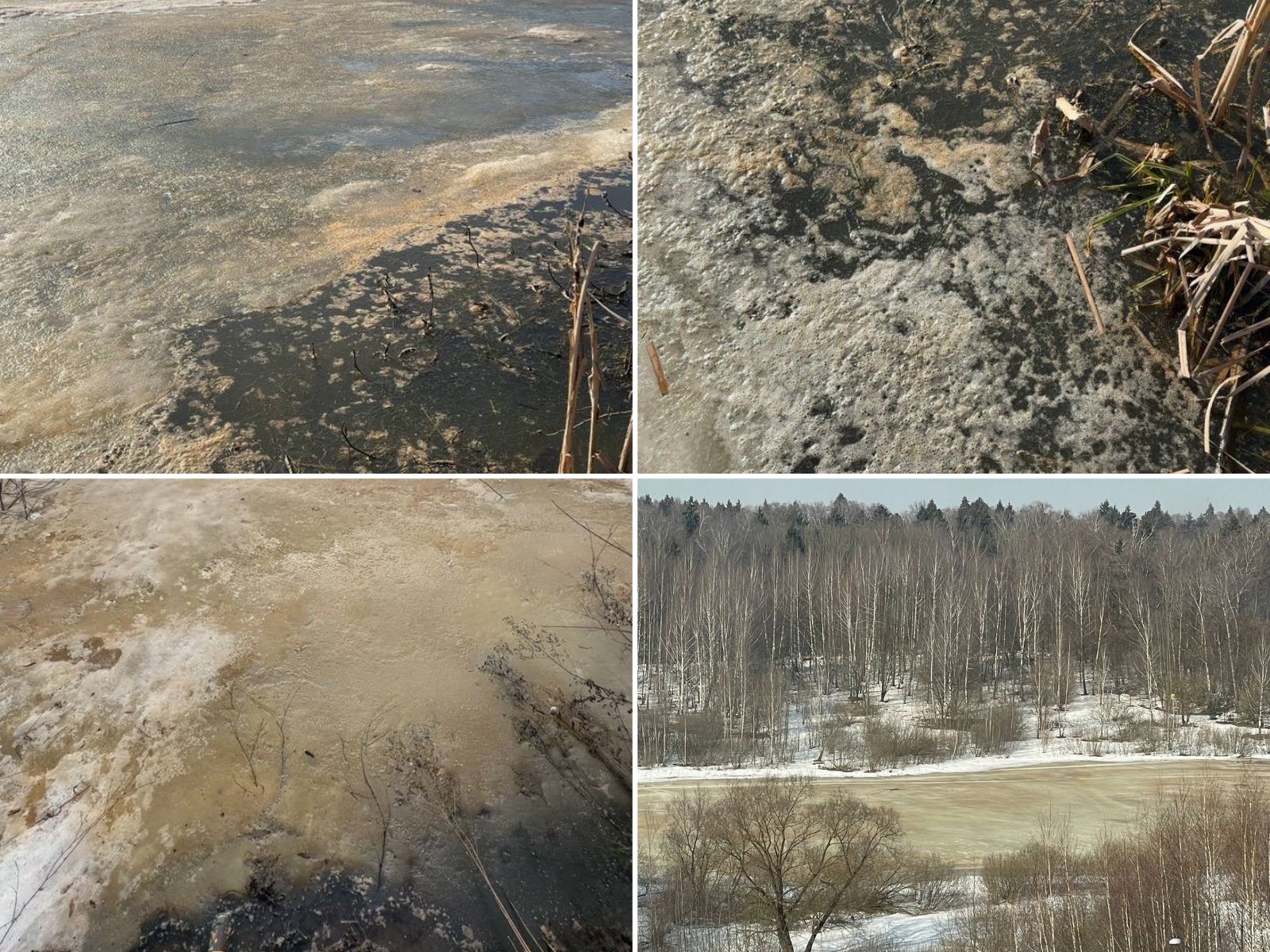
I carefully studied the chronology of the problem. Local residents and the media are united in the view that the main source of sewage odors is the chemical plant JSC “Fine Organic Synthesis Production Association” in Dolgoprudny and the аварийный pipeline belonging to it. In August 2024, Moscow ecologists established that through a leaking 2.5-kilometer pressure pipe (laid in 1957), the plant’s wastewater enters the city sewer system and then the ponds within Moscow’s territory. By the beginning of autumn 2024, at least three ruptures of this pipeline had been recorded, one of which was repaired by Mosvodokanal around the clock (an excavation 9×6 m, more than 7 m deep). The remaining leak sites were on the territory of Dolgoprudny; for various reasons, the plant administration did not fully eliminate them. Thus, untreated chemical wastewater from the TOS territory continues to enter Kuznechikhin and other ponds, where residents have long noticed this problem (including mass fish deaths).
In other words, I think the situation is clear: the plant’s infrastructure has “rusted through completely,” they simply patch holes from time to time, but it is impossible to contain the catastrophe. We have a huge number of such “time bombs” in the country; as you may recall, there was recently a catastrophe in Anapa, where tankers carrying petroleum products sank. That happened for the same reason: they had rusted through, they should have been written off long ago, not still used to transport dangerous cargo in a marine area.
What is needed is a large-scale reform — a state-level push to pull out everything old and “worn out,” to renew it, to modernize it. Not only production methods have changed, but technologies and treatment facilities as well. But here everything is outdated, accident-prone, and the problems are only growing, creating threats both to nature and to people.
I also studied the situation in Dolgoprudny and the actions of local residents. They are doing everything right! They are tremendous people — heroes of our time. While millions remain silent, a few are uniting and trying to change something. This is the real struggle for Life, the very Mission to which you and I dedicate ourselves.
Following residents’ appeals, inspections were carried out by Rospotrebnadzor, Rosprirodnadzor, Rosprirodnadzor Moscow, and the Ministry of Ecology of the Moscow Region. Official documents confirm the presence of exceedances of dangerous substances at the boundary of the TOS zone: several control points recorded elevated concentrations of pollutants, including hydrogen sulfide. A Rospotrebnadzor letter noted a “subjective sensation of the smell of hydrogen sulfide when the wind blows from the direction of JSC ‘PO TOS’.” And the Ministry of Natural Resources, as I wrote above, reported violations by private homes.
It turns out that all agencies understand the problem, and the pollution is officially confirmed, but there are no preventive measures at all. They limit themselves to formal replies, as always.
For their part, people are keeping detailed records of incidents (the water bodies “turned” rusty, oily films appeared), collecting 112 calls, complaints to Rosprirodnadzor, Rospotrebnadzor, the prosecutor’s office, and the Departments of Ecology of Moscow and the Moscow Region. The first large package of documents has been assembled (more than 20 response letters from regulatory agencies). Residents have gone to court, and now they will have to take part in difficult legal proceedings. People are preparing additional appeals to the authorities: to Moscow Region Governor Vorobyov, Deputy Mayor Biryukov, the Popular Front, and, as I said earlier, a meeting between residents and a State Duma deputy has been announced.
More than that, if I understood correctly, local residents managed to secure the installation of two automatic monitoring stations on the boundary of the affected area. However, they measure only hydrogen sulfide and do not allow tracking of thiols and other substances whose smell residents complain about. Accordingly, there is a serious gap in monitoring.
In the letter people sent me, it is stated that by March 2026 oily stains and a rusty color of the water had appeared in the “Long Ponds.” On those same dates, local residents recorded a worsening of the foul smell, describing it as poisoning with physical consequences such as tears, a sore throat, nausea, dizziness, and allergies in children. This usually occurs under the effects of low-concentration emissions of H₂S and mercaptans. This information received indirect confirmation from official sources: a MosEcoMonitoring study during the Moscow “mercaptan” incident recorded methyl mercaptan in the air at 0.3 MPC (and the smell is noticeable at that dose); an analysis by Rospotrebnadzor Moscow shows that H₂S, when above the MPC, causes irritation of the mucous membranes and headaches.
I can confirm, based on the results of studying the materials sent to me, that the problem is systemic and is not being resolved in any way. In reality, people are now damaging their health, with possible serious consequences ahead.
Constant inhalation of hydrogen sulfide (H₂S) and organic thiols (mercaptans), even in low concentrations, is fraught with acute symptoms. Even a slight exceedance of the MPC for H₂S causes irritation of the mucous membranes, headaches, and nausea. High concentrations can lead to pulmonary edema, coma, and even death.
Mercaptans (the smell of rotting meat), according to the Rospotrebnadzor classification, belong to hazard class II: they significantly affect the liver and, at very high concentrations, may be fatal.
Chronic exposure to such substances is associated with a deterioration of general health: fatigue, nervous system disorders, and allergies. Open studies on the risks of industrial emissions of thiols and their metabolites confirm their toxicity: petrochemicals and pharmaceuticals are sources of heavy organic compounds.
As for the discharge of untreated chemical wastewater into water bodies, I think the problem is obvious to everyone: above all, this leads to the death of aquatic organisms and the destruction of ecosystems. Local residents are essentially living next to large poisonous puddles. Activists have already reported fish deaths in Kuznechikhin Pond (and other water bodies) after TOS accidents. Toxic organic substances such as solvents, phthalates, and heavy metals in wastewater cause eutrophication and contamination of water bodies with pathogens. I am especially alarmed that the “Long Ponds” reserve is being polluted; this is a specially protected natural area of regional significance (Faunal Reserve, 115.4 hectares), where Red Book birds nest (gulls, herons, long-eared owls).
People point to the rusty color and oily stains in the water bodies; this is the crystallization of hazardous substances, which can disrupt the local biocenosis and cause poisoning in local birds. In general, everything is dying — just not at once, but slowly and painfully.
And the human being.
And nature.
That is the scale of the problem, Allies! Even in the heart of our country, right near Moscow, on one side they are cutting down Losiny Ostrov National Park, and on the other side people are being poisoned by emissions from the chemical industry. And nothing seems capable of changing it: people are fighting, defending their right to Life, but under the indifference and absolute apathy of millions, they are unable to cope with the catastrophe.
Spread this material as widely as you possibly can! The voices of local residents must be heard.
© PAVEL PASHKOV
Support the fight!
The hardest thing in our time is to remain independent from government and business! All activities are carried out independently. Stand with us and support our Mission to protect wildlife.
I want to support!Concept of TFET
The world is going through the sixth mass extinction of species; in just the last 50 years, humans have destroyed about 73% of all animals on the planet. We are experiencing a real environmental collapse on a planetary scale. It is urgently necessary to establish Territories of Full Ecological Tranquility (TFET) — we are trying to achieve a complete overhaul of the existing protected areas system.
Learn moreTake action
Take part in our public project to support wintering birds during the frosts — tens of thousands of people have already stood up to protect
Learn moreShare this material!


