
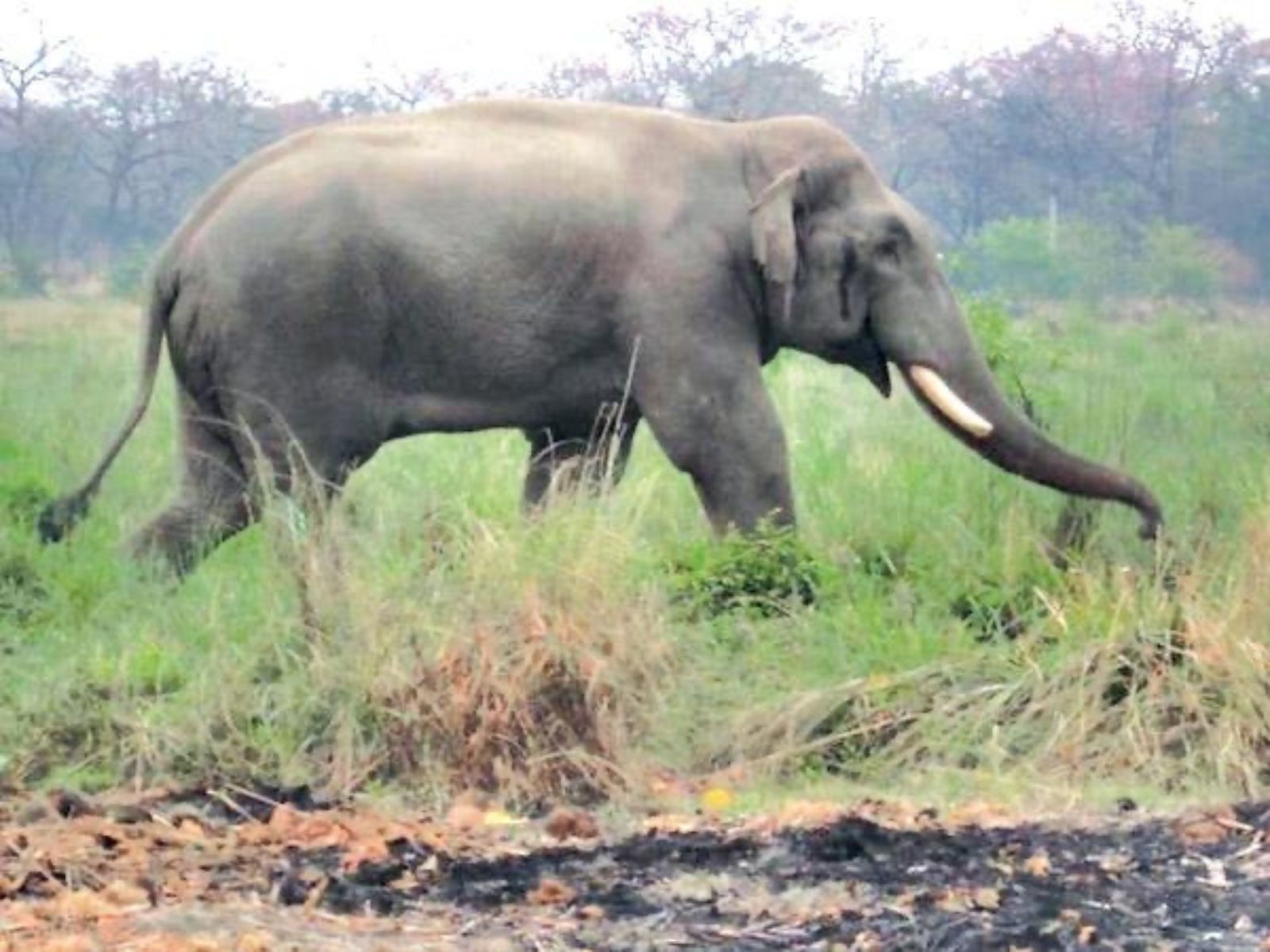
A very revealing case of the attitude toward wildlife and conflict with humans: on July 6, 2026, the Nepali publication The Kathmandu Post published an article titled “Dhrube, the lone elephant who stalked one family for 14 years.”
Essentially, this is what happened: in Nepal, on the outskirts of Chitwan National Park, there lives a wild elephant named Dhrube. In 2012, this elephant killed the parents of a local resident, Shanichara Bote — Budhiram and Jharali. After that, Shanichara moved to another area, and after the trauma he had endured, he was left with an extreme fear of wild animals. Fourteen years later, the same elephant attacked Shanichara’s family again: in his new home, his 25-year-old daughter-in-law Ashika Bote and four-year-old grandson Bharat Bote were killed.
Thus, according to the report, the family lost four people in 14 years because of the same wild elephant. Moreover, according to Chitwan National Park, Dhrube began attacking settlements in 2010, and he is linked to the deaths of at least 25 people. The authorities track his location with a GPS collar, and on the night of the attack, his coordinates were recorded near the scene of the tragedy.
The question, of course, remains: why was no alert issued and why did specialists not go to the site if the elephant had approached the settlements? In other words, what is the point of a GPS tracker at all if you are well aware of growing conflicts but do not set up a system to warn of future conflicts?
I would like to quote from The Kathmandu Post:
“On December 16, 2012, Shanichara Bote sat motionless at Baruwa Bazaar in Madi beside the lifeless bodies of his father Budhiram and mother Jharali. They had just been trampled by Dhrube — the notorious wild male elephant that had begun terrorizing the outskirts of Chitwan National Park.
After that tragedy, Shanichara completely changed his life, trying to escape the constant threat of wild animal incursions. He crossed the Reu River, skirted the main boundaries of the national park and crossed the Rapti River to settle in Jagatpur. But despite the desperate move, the shadow of the lone elephant followed him.
On Sunday afternoon, Shanichara was found in a state of deep shock at the District Police Office building in Chitwan. Just a few hours earlier, in the quiet midnight hours of Saturday, that same wild elephant had broken into his new home and killed his daughter-in-law Ashika Bote, 25, and his four-year-old grandson Bharat Bote.
A systemic failure of measures to mitigate human-wildlife conflict in the country’s major conservation zones destroyed Shanichara’s family: over 14 years, it lost four people because of one animal.
“We originally lived in Dropatinagar, in the Madi area, but the constant terror of wild elephants forced us to sell everything we had and move to Jagatpur,” Shanichara said, while waiting for the police to complete the post-mortem procedures.
“We believed that moving across large rivers would make us safe. But after all these years, that very elephant found us again, attacked our home, and took my daughter-in-law and my little grandson. We have nowhere left to run.”
According to official park records, Dhrube first began attacking human settlements and causing deaths in 2010. Since then, this settlement-raiding giant has been directly responsible for the deaths of at least 25 people in the region.
“We use a satellite collar to track the movements of this extremely aggressive male elephant,” said Abinash Thapa Magar, information officer and spokesperson for the conservation service of Chitwan National Park. “Our data logs show that on Saturday night his coordinates were recorded right along the perimeter of the incident site.”
He added: “Before this tragic incident, Dhrube was officially credited with 23 human lives. With the two latest victims in Jagatpur, the confirmed death toll linked to this single elephant has now risen to 25.”
Among Dhrube’s many victims were also two soldiers deployed for anti-poaching work and park security.
The story of this lone elephant reveals a long-standing regulatory dilemma. After the deaths of Shanichara’s parents in 2012, an emergency high-level meeting chaired by the chief district officer issued an official order to track down and kill the elephant. This was followed by an intensive two-week military and conservation operation to search for the animal in the dense forests of Chitwan.”
“Park staff and soldiers opened fire on the elephant twice in late December 2012, severely wounding him. However, the resilient animal managed to retreat deep into the jungle. The operation cost the state treasury more than 1.6 million rupees. Dhrube was believed to have died from bullet wounds, but in the winter of 2016 he mysteriously reappeared in the western sectors of Chitwan.
By 2019, Dhrube had expanded his territory, entering eastern Chitwan and the Barandabhar forest corridor. This forced the authorities in May 2020 to fit him with a second satellite collar, since the first radio collar, installed in late 2012, had stopped transmitting signals.”
“Lal Bahadur Dawadi, chairman of the Ghailaghari Buffer Zone User Committee, said that Dhrube had been actively staying near forest edges and entering human settlements for the past nine to ten days.
“This animal moves along a cyclical route and returns to the villages every year, which means his presence was completely predictable for the park administration,” Dawadi said.
Keshav Lamichhane, a 72-year-old resident of Jagatpur-Belhatti in Bharatpur Metropolitan City-23 who has lived in the area since 1985, confirmed that Dhrube’s raids peak during the autumn and winter harvest seasons.
“When rice and corn ripen, Dhrube appears as if on schedule,” Lamichhane said. “Just a couple of years ago, he attacked a neighboring village, threw sacks of harvested rice onto his back, and went back into the jungle. However, this is the first time he has committed such a brutal killing of people directly in our area.”
I have deliberately translated a large section of the text for you so that you understand what is happening without distorted translations or “facts taken out of context.”
Now let us examine what actually happened. A tragedy is terrible. But it is even worse that this tragedy was allowed to happen and that no truly effective system for preventing conflicts exists. In the article itself, everything is presented as if the elephant specifically “stalked the family,” but this is not the case.
Young male elephants, as they mature, are pushed out of maternal herds by dominant males and begin to live solitary lives. This is precisely the case with Dhrube — he became a solitary male who found food near humans. At the same time, the materials about Dhrube themselves indicate that these were not random attacks, but a repeated elephant route along forests, rivers, villages, and fields. In other words, every year he migrated along his life path, inevitably encountering humans because of large-scale development and the absence of ecological corridors. In fact, local residents themselves say that the elephant’s appearances intensify during the rice and corn ripening season.

I checked studies on Nepal. In central Nepal, in the buffer zones of Chitwan and Parsa, elephants often damage rice in particular. Specialists conducted a review covering the period from 2008 to 2012. According to it, 87% of compensation claims for crop damage were linked to raids on rice, while wheat, corn, bananas, millet, sugarcane, and mustard were also damaged. In addition, conflicts specifically involving wild elephants occur there on a regular basis. In the studies, I found data showing that out of 14,989 registered cases of conflict with large animals, crop raiding was the most frequent type of incident, and elephants were associated with 42.8% of all incidents.
And this is important: this is not about an “evil wild elephant” who tracked a specific family for 14 years in order to trample and destroy them all out of hatred for humans. The matter is simply that a wild solitary elephant comes to places where there is food.
I studied additional research on the habitat range of the Asian elephant in Nepal. According to it, by 2020, 21.5% of the areas important for the survival of the population had been lost. At the same time, the area of large forest blocks DECREASED BY 43.08%, while the remaining small fragments, various patches torn apart into pieces, increased many times over.
The scientific paper is titled “Monitoring Forest Loss and Fragmentation in the Asian Elephant (Elephas maximus) Range in Nepal from 1930 to 2020” and was published in 2021.
Let me quote the scientific paper:
“The continued habitat loss and fragmentation probably fragmented elephant populations during the last century and made them insular with long-term ramifications for elephant conservation and human-elephant conflict.
Given the substantial loss in forest cover and high levels of fragmentation, improving the resilience of elephant populations in Nepal would urgently require habitat and corridor restoration to enable the movement of elephants.”
So, as you can see, scientists warned about this problem five years ago, and all objective assessments show that elephants are simply running out of places to live and find food, and this inevitably affects the growth of conflicts with humans.
In addition, as is known, in 2012 the authorities issued an order to track down and kill Dhrube. They failed to do this, but park staff and the army fired at him twice in late December 2012. The elephant was severely wounded and retreated into the jungle. Most likely, bullets still remain inside his body, causing pain throughout his life.
And this is very important: an animal that has been shot at, pursued by soldiers and rangers, survived being wounded, and still feels pain will be extremely dangerous and unpredictable. Elephants, as is well known, have very strong memories, complex social behavior, and high sensitivity to threats. Therefore, at the sight of a human — and especially armed park staff or soldiers — the elephant will immediately try to protect himself.
Therefore, of course, the people who died are victims. This should not have happened. But the elephant is not a criminal; he is an animal that has been deprived of his habitat and food base. There are no natural corridors for migration, while directly along his route there are places where he can try to obtain food: human-altered territories used for large-scale agriculture.
Moreover, the authorities knew perfectly well that the elephant had been staying near human dwellings for 9–10 days, but they did not prevent the tragedy. The GPS collar transmitted coordinates once an hour, which means it was possible to go to the site and control the animal’s passage. Before that, they had tried to kill the elephant, shot at him, and pursued him for years. Realizing that he was near human dwellings in the hope of finding food, he was constantly looking around, afraid, and, upon seeing a human, decided to attack first.

And he will continue to do this. Humans have only two options: either conflicts will increase and the elephant will have to be killed — and then all the others who come in his place. Or a Territory of Complete Ecological Peace (TCEP) must be created in this region, connecting fragmented natural areas into a single conglomerate through ecological passages along the migration routes of species, integrating modern systems for preventing conflicts between wild animals and humans, and beginning the transition toward normal coexistence between Humanity and Nature.
And today we propose such a solution: a concrete Concept of Territories of Complete Ecological Peace. Somewhere this must begin, someone must change the world, but for this it is necessary to realize the scale of the planetary crisis and move toward a collective struggle for Life!
And the elephant Dhrube, like each of us, like all wild animals on Earth, has the right to Life. Everything he is doing now is a struggle for his survival.
© PAVEL PASHKOV
Support the fight!
The hardest thing in our time is to remain independent from government and business! All activities are carried out independently. Stand with us and support our Mission to protect wildlife.
I want to support!Get involved
On an ongoing basis, we launch public initiatives together to protect wildlife and achieve real change. Join this work and help change the world for the better.
Explore the initiativesTFET Concept
We are working to transform the global protected-area system — Territories of Full Ecological Tranquility (TFET) must be created. Wildlife needs refuges from human pressure! This is one of the key paths out of the planetary ecological crisis and toward preventing further ecosystem collapse.
Learn more
