
The struggle for animals listed in Russia’s Red Book continues. In my view, we have a vivid example of the utterly destructive work of a conservation authority: the Ministry of Natural Resources, which appears to be thoroughly permeated by lobbying groups. And while some are trying to appropriate nature reserves and legalize the exploitation of mountain forests and specially protected natural areas, others are actively pushing through bills that weaken the protected status of endangered animal species in the interests of trophy hunting.
In earlier materials, I explained exactly how Russia’s Red Book was being eroded and where it began. The horizon of events is only a few years, and during that time, carefully, through small decrees, the protected status of wildlife was deliberately lowered. The current bill, which they are trying to adopt right now, as you understand, creates a permanent and scalable administrative infrastructure that is potentially suitable for expanding the practice of targeted lethal removal of rare species. We are talking about the killing of animals that are already on the brink of complete extinction.
We are seeing a destructive system that is being presented to us as completely without alternative. But how should a system for protecting endangered animal species work in a normal way?
Let us try to understand.
The current structure of the protection regime for rare species in Russian law changed dramatically after August 1, 2021, when the most crushing blow was dealt to the Red Book. And the law itself became paradoxical.
Look.
First, the updated Article 24 of the law “On the Animal World” states that actions capable of causing the death, reduction in numbers, or disruption of the habitat of species included in the federal or regional Red Books are not permitted.
Second, the same Article 24 establishes an “exit route” through an exceptional permitting regime: the circulation of objects listed in the Red Books is allowed in exceptional cases with the permission of a “specially authorized” body in accordance with the procedure established by the Government.
And third, amendments were made to the law “On Hunting” — Federal Law No. 455-FZ invalidated Part 4 of Article 11 of the hunting law and introduced a new Article 11.1 in its place. Under the previous logic of the law, there was a direct special ban on hunting mammals and birds listed in the Red Book. But in the new version, that direct ban was simply cut out and replaced with a new formula: the harvesting of Red Book-listed hunting resources is prohibited, but is permitted in exceptional cases in the manner предусмотренный by the law “On the Animal World”.
Thus, direct access to the killing of animals listed in the Red Book was opened to the hunting community. Scientific data began to be replaced by “monitoring” data.
And all this began to happen systematically precisely after high-ranking, influential hunters in power, belonging to “closed trophy-hunting clubs,” publicly called for the legalization of trophy hunting of animals listed in the Red Book. At the same time, the Ministry of Natural Resources officially stated that it was considering such proposals.
The current decree, which we oppose, already creates a broad digital system with online issuance of permits for the shooting of rare species. That is, this is not closed departmental work, where the necessity is identified by a state expert review and the animal is removed from the wild by scientific specialists, but a large-scale digital system in which it is expressly stated that both private individuals and businesses (legal entities and entrepreneurs) will be able to obtain access.
So, I think you understand the structure of what is happening. This is how the Red Book is being diluted. And yes, in my view this is a completely destructive system if we are talking about the protection of wildlife; but if we are talking about a system that provides rich trophy hunters with access to fragile populations of endangered species, then everything is fine, everything is being done exactly as needed. But in that case, perhaps it would indeed be necessary to rename the Ministry of Natural Resources as the “Ministry of VIP Hunting of Endangered Animal Species.”
PRESUMPTION OF ZERO LETHALITY
Now I will show you a model of a NORMAL management system, how animal protection should be ensured. In such a system, the main task is to make the presumption of zero lethality the key principle.
It should probably be clarified immediately that we are talking about species on the brink of extinction, and, as is well known, all species are included in the biocenoses of wild nature and provide certain biological services. When a species goes extinct, the entire framework of ecosystems begins to crumble, other interconnected species die, and rapid and inevitable degradation begins. That means the cost of any mistake in attempts to “regulate” endangered species can be fatal.
At present, the list of permissible reasons for killing rare species is far too broad. In reality, the only admissible grounds in the most critical situations can be just three reasons:
A situation of direct threat to human life and health, but even then lethality for a rare animal must be the very last critical line. In other words, this should not be determined by BUSINESS, but by a профильная expert group that goes to the site and gives an оперативная assessment with full reporting afterward on whether it was possible to apply NON-lethal methods.
A sanitary emergency situation, but in this case it can be a valid ground only where there is a proven transmission mechanism and scientifically substantiated effectiveness of the measures specifically for protecting health. But even in this case, barriers, vaccination, quarantine, and preventive infrastructure measures must be considered first; lethality only where the ineffectiveness of alternatives has been proven. Again, access to this may only be given to specialized state experts.
And the last point is the forced euthanasia of a severely injured individual. But this point is often precisely the most abused “soft” ground. Therefore, control must be strict, clearly prescribed in law, and any manipulations must be carried out only and exclusively by specialized experts. This is permissible only when, for example, an animal has been hit by a vehicle and it has been proven (and documented) with full video and photo reporting that the injuries are incompatible with life.
That is all. No other reasons are appropriate at all, ever. But in our system the reasons are expanded; they include other points as well.
- For the purposes of conserving wildlife objects.
- For monitoring the state of their populations.
- For regulating their numbers.
- For protecting public health.
- For eliminating a threat to human life.
- For preventing mass diseases of agricultural and other domestic animals.
- For ensuring the traditional way of life of the Indigenous small-numbered peoples of Russia and representatives of other ethnic communities whose distinctive culture and way of life include traditional methods of protecting and using wildlife.
- For other citizens who permanently reside in the given territory in places of traditional residence and traditional economic activity of Indigenous small-numbered peoples and who, on lawful grounds, are included in one of the groups named in Part 1 of Article 49 of the law “On the Animal World.”
I will explain what should be removed from the law and recognized as a critical defect of past years:
The harvesting of rare species is allowed for some kind of “monitoring.” If this point is to remain, then it must be clearly specified that no monitoring may include the death of individuals. But in that case we come to the central term itself — “harvesting,” which implies the exact opposite meaning, and this terminology must be changed to “temporary removal for monitoring purposes, with subsequent return to the habitat.” With a fully documented report.
The same applies to the point “for the purposes of conserving wildlife,” a very broad motive that can be applied in completely different ways. Suppose a tiger is eating its prey — can a hunter shoot the tiger in order to save the consumed animal? From the standpoint of legislative logic, this would be justified, because the killing was committed for the purpose of conserving wildlife. There are no clarifications in the law, but they should exist if the discussion concerns non-lethal methods of “removal.”
Further, we have “harvesting” allowed supposedly for the purpose of regulating numbers. This point must be removed completely and also recognized as a systemic defect. What kind of “regulation” of species on the brink of extinction can even be discussed? Regulation implies the deliberate reduction of a species’ numbers, but if a species is listed in the Red Book, that means its numbers are, by definition, in a critical state.
And lastly, what must also be removed is, of course, the “harvesting” of rare animal species for the purpose of ensuring a traditional way of life. This is not even a loophole in the legislation, but a deliberately laid “tunnel” for trophy hunting of rare species.
I will tell you a story.
In the elite trophy hunters’ club that in 2018 proposed giving money to our Ministry of Natural Resources for the killing of rare species, and afterward whose members (high-ranking officials) openly pushed through the legalization of direct trophy hunting of animals from the Red Book, there is Sergey Yastrzhembsky. He is a former aide to the current president of the country and press secretary to Boris Yeltsin; he travels the world shooting animals. He has killed the Big Five in Africa and other extremely rare animals as well.
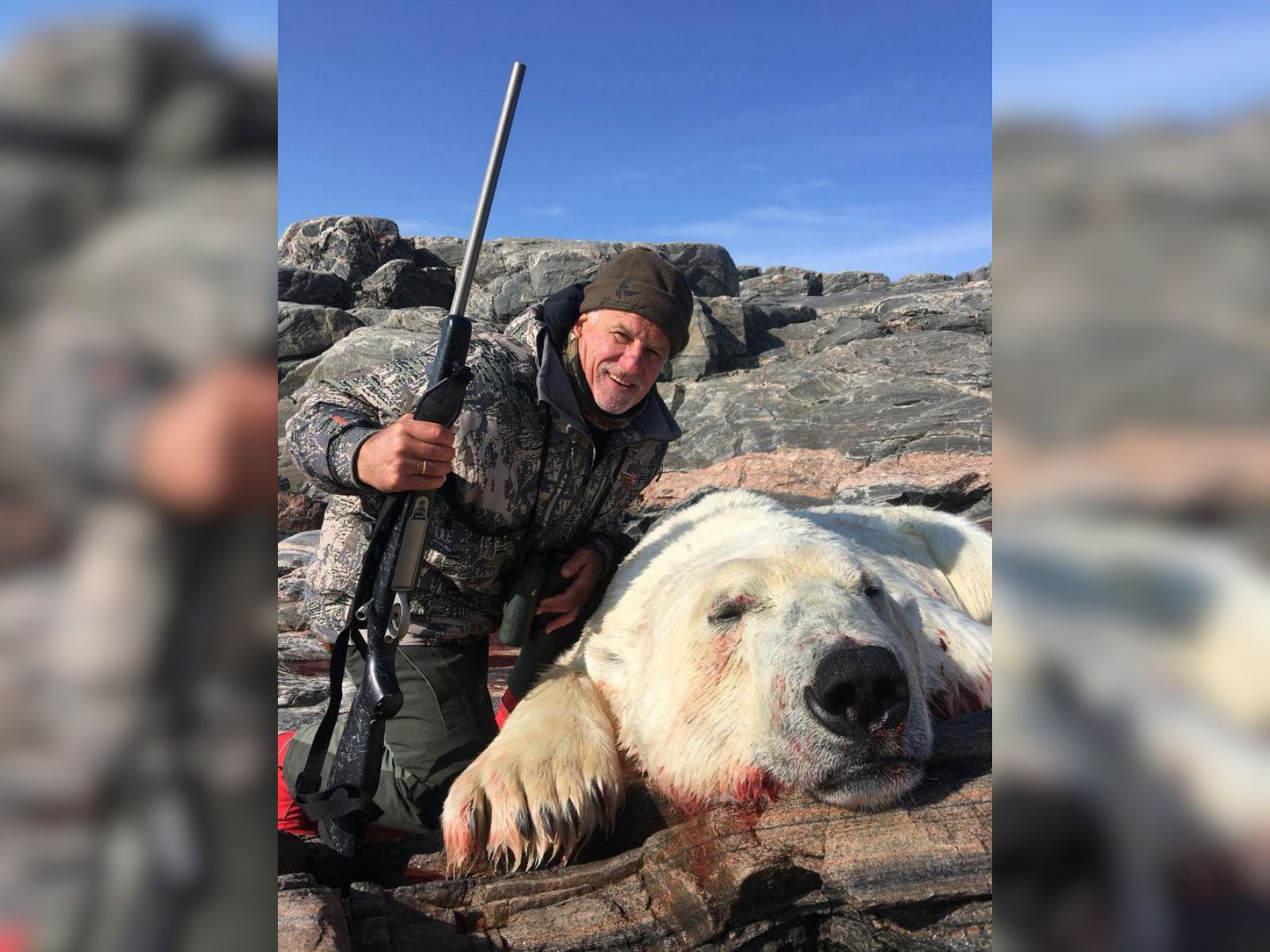
On January 14, 2019, he boasted about killing a polar bear in an article under the headline: “With the Inuit for a Polar Bear,” where he himself describes the hunt for a polar bear in North America. He arrived and, together with local residents, “triumphantly” killed a bear that is, in fact, on the brink of extinction worldwide.
And the key here is “with the Inuit” — for them in Canada, just as in our country, a special regime of traditional harvesting has also been established. This is done through the issuance of a quota via an Inuit community; in Nunavut and other Arctic jurisdictions of Canada, polar bears may be harvested within quotas issued for local residents. And local structures sell them to wealthy trophy hunters. It is simple: real Indigenous residents carry heavy bags on the hunt for their “white sahib,” and also track the prey for him. He, that same gentleman, only has to pull the trigger in order to commit the killing.
That is all. Since the killing was committed legally, this is most likely the kind of commercialized model he used.
I do not think further explanation is needed: the provision on the “harvesting” of rare species for Indigenous peoples must be struck out. This is, in fact, a real legislative contradiction — to scientifically record the risk of species extinction, and then hand animals over to be killed not on emergency grounds, but on ordinary economic and cultural grounds.
I think Indigenous peoples would agree with me as well if they want to preserve their nature and the wealth of their land: the use of wildlife is permissible only where it does not lead to a further decline in numbers. That is fair.
To invoke outdated practices, as officials from the Ministry of Natural Resources do, saying that some justifications existed in the 1997 law, is untenable. The world is moving forward; more scientific evidence, reports, and studies are emerging. How can we remain stuck in outdated archaic notions when, for example, meta-reports on breached planetary boundaries and species extinction are only now appearing?
After all, that is like measuring the modern internet by judging it through the notions of the 1990s. At a minimum, people would consider you narrow-minded, out of touch with life, lost somewhere in the distant past. Or they would simply consider you feeble-minded.
In a normal model for protecting animals on the brink of extinction, the decisive force must be scientific expertise. Whenever any removal of such species from the wild is attempted, a report signed by specific scientific specialists must be provided, and that report must contain at minimum the species, the reason, the nature of the risk, information on the rejected non-lethal alternatives and the scientific data used, as well as data on the means of control and implementation. All of this should be entered into a public register accessible to everyone, and should also include subsequent measures for restoring numbers and a full report on the state of the population.
Thus, the proper architecture, where the state wants to preserve the truly exceptional nature of removing rare species, should be as follows:
- Only narrow and limited grounds
- Full testing of all non-lethal removal alternatives, with proof of their impossibility (when making a decision on lethal action)
- Independent and state expert review (including emergency review if there is no time)
- Strict public reporting
- A clear mechanism of liability and revocation of permits
- Lethal methods must be carried out only with evidence (photo/video) and a formal record, only by state-licensed experts under the supervision of scientists, who in cases of abuse will bear personal responsibility for the death of a rare animal
But in our country everything is different, and it is precisely in this that I see active lobbying for the interests of trophy recreational hunting. If the killing of a rare species may be entrusted to a private individual or, all the more, a commercial operator, and if all the current grounds are described by the hunting term “harvesting,” then it is already clear that this has nothing to do with the conservation of wildlife.
© PAVEL PASHKOV
Support the fight!
The hardest thing in our time is to remain independent from government and business! All activities are carried out independently. Stand with us and support our Mission to protect wildlife.
I want to support!Concept of TFET
The world is going through the sixth mass extinction of species; in just the last 50 years, humans have destroyed about 73% of all animals on the planet. We are experiencing a real environmental collapse on a planetary scale. It is urgently necessary to establish Territories of Full Ecological Tranquility (TFET) — we are trying to achieve a complete overhaul of the existing protected areas system.
Learn moreTake action
Take part in our public project to support wintering birds during the frosts — tens of thousands of people have already stood up to protect
Learn moreShare this material!


